
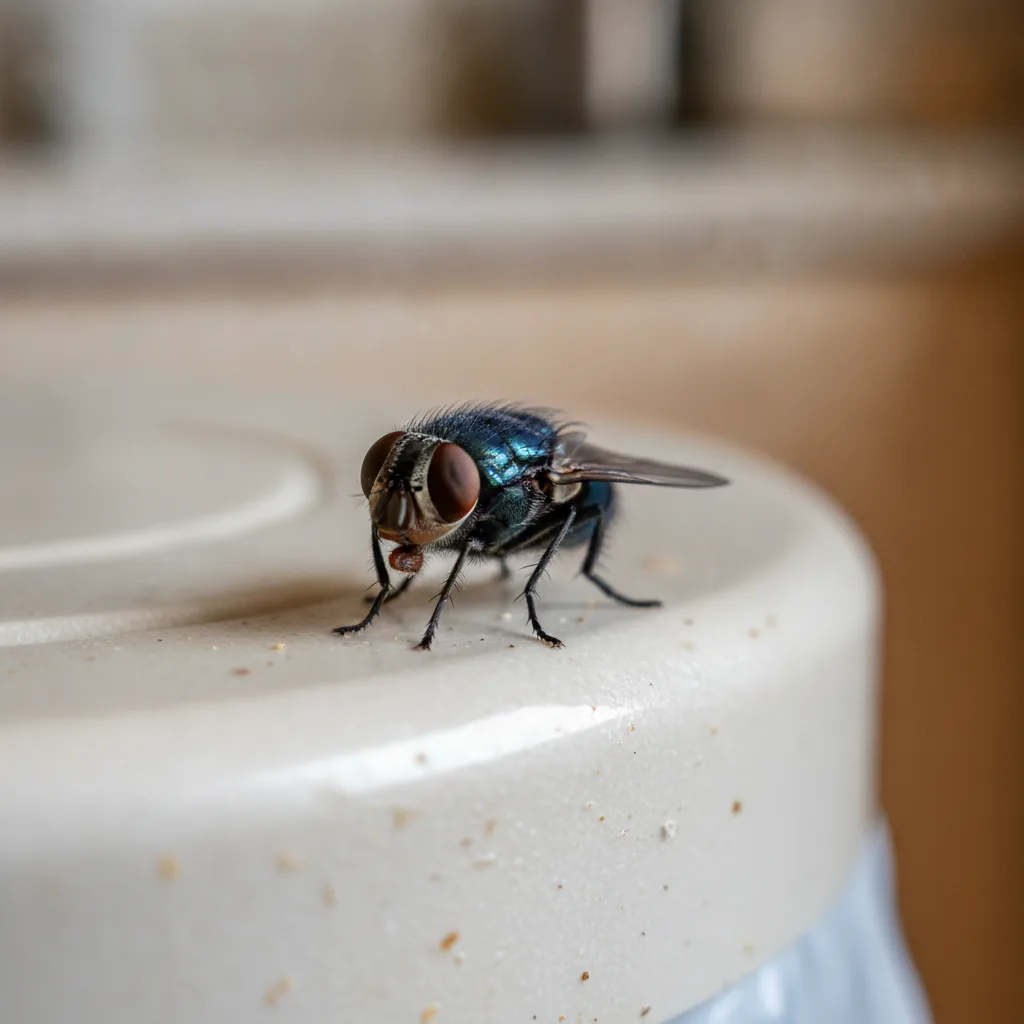
To get rid of house flies, find and remove what they’re breeding in first, whether that’s garbage, dog waste, a dead animal, or rotting food, because killing adults does nothing while the source keeps producing more. Once the source is gone, seal and screen the entry points flies are using to get inside. Knock down the adults that are left with sticky traps, fly lights, or baits. If the flies keep coming back no matter how clean the house is, that usually means a hidden breeding source somewhere indoors.
House flies are the bigger, faster, buzzing flies you find near trash, pet waste, and open doors, not the tiny ones that hover over a fruit bowl or a houseplant. If your problem is small flies hanging around produce, potting soil, or a sink drain, that’s more likely fruit flies, fungus gnats, or drain flies, and the fix is different. This guide covers the large flies: where they’re coming from, how to shut that off, and when the job needs a licensed company.
Where the flies are gathering tells you what to fix
Forget trying to name the species from across the room. What moves a fly problem is where the flies collect and what’s sitting there. Walk the house and the yard and note the spot they keep returning to, because that spot is usually the answer.
| Where you keep seeing them | What to check there |
|---|---|
| Kitchen, bins, patio door | Trash can lids, the bin itself, food residue in recycling, a propped-open slider |
| One window or one room, over and over | Something dead or rotting behind that wall, in the attic, or under the floor |
| Back yard, near the fence or bins | Dog waste, open compost, fallen fruit, an outdoor can with no lid |
| Attic or upstairs windows, sluggish flies | An attic space that needs opening up and checking |
| Fruit bowl, potting soil, sink drain | Not house flies. See our fruit fly and gnat guide |
If the flies are big, loud, and clustered around trash or one bad smell, the rest of this guide is the right one. If they’re tiny and hovering over produce, a plant pot, or a drain, the other guide is.
Why house flies show up in San Diego homes
Flies are made somewhere. Every fly in your kitchen developed in something soft and rotting, and that something is almost always within a short flight of the door.
The sources are ordinary. Trash cans without tight lids, backyard compost, and dog waste left in the yard all give flies somewhere to lay eggs close to the house. A property with horses, chickens, or other livestock, common enough in semi-rural East County around Lakeside, adds manure and feed areas to that list. None of that is a reason to spray first. It’s a reason to walk the property and find what’s producing them.
Fly activity also tracks with the broader San Diego pest calendar. If you want the full year-round picture of what’s active when, see our San Diego pest season calendar.
How to get rid of house flies in San Diego, step by step
Getting rid of house flies in San Diego comes down to five steps, done in order. Skipping straight to traps or sprays without finding the source is the most common reason a fly problem doesn’t go away.
| Step | What to do | San Diego note |
|---|---|---|
| 1. Find the source | Walk the property and check trash areas, yard, garage, and anywhere a bad smell has appeared | Start outdoors: bins, dog waste, and open compost are the easiest to check and fix |
| 2. Clean it up | Remove the breeding material, bag it, and get it out of reach | Double-bag anything rotting before it goes in an outdoor bin |
| 3. Seal and screen | Fix torn screens, add door sweeps, keep doors closed | A patio or slider door propped open on a warm evening is an open invitation |
| 4. Trap and knock down adults | Use sticky traps, a fly light, or a bait station for the flies already inside | Place traps away from food prep areas and away from where guests sit |
| 5. Treat every source | Repeat steps 1-2 for any additional breeding spots, not just the first one you found | Multiple trash cans, a shed, and a yard often each need their own pass |
The order matters. Sanitation and exclusion stop new flies from being made. Traps only clean up the ones already flying around.
What actually works, and what only looks like it does
Sanitation and exclusion do almost all the real work, because removing the breeding material and blocking the ways in stops the problem at the root instead of thinning out the adults. Everything else is a supporting tool, not a fix on its own.
Sticky traps, fly lights, and bait stations are worth using for two reasons. They catch adults that are already inside, and the catch count tells you whether your source removal is working. A trap that fills back up in two days means you haven’t found everything yet.
Foggers and aerosol sprays reach only what is flying in the room when you use them. They do nothing to the material the next generation is developing in, so if the source is still there, so is the problem. Treat any product that promises to solve a fly problem without touching the source the same way.
How to keep house flies from coming back
Keeping house flies away is mostly about denying them a place to breed. Use trash cans with tight-fitting lids, both inside and outside, and take kitchen trash out before it starts to smell. Rinse recyclables before they go in the bin, since food residue in a recycling container is an easy breeding spot people overlook.
Pick up dog waste from the yard daily rather than weekly. Keep any compost pile covered and turned, and don’t add meat or dairy scraps to it. Check window and door screens for tears and patch or replace them, and add door sweeps to exterior doors that don’t seal tightly at the bottom. These habits cost nothing and do more than any trap or spray.
When to call a pest control pro
A fly problem that won’t quit after thorough clean-up points to a breeding source you can’t see or reach. A dead rodent inside a wall, attic, or crawlspace is the one homeowners most often can’t get to. That’s a job for someone who can open up the space, not another round of sticky traps.
We don’t inspect, treat, or apply anything. We match San Diego County homeowners and businesses with licensed local companies, and the matched company inspects, finds where the flies are coming from, and quotes in writing before treatment begins. Fly work is general household pest control, which in California is Branch 2: the practice relating to the control of household pests excluding fumigation with poisonous or lethal gases. Verify any company at pestboard.ca.gov, and note that cancelled licenses don’t appear in those search results, so contact the Board directly if a record comes up empty.
If the cause turns out to be a dead rodent or an ongoing rodent problem, rodent control is the referral that fits. For recurring pressure tied to trash, yard waste, or sanitation, general pest control covers it. Restaurants and food businesses face a heavier version of the same problem; see our guide to commercial pest control for Escondido restaurants. To get matched, call (858) 400-6561.
Frequently asked questions
Why do I suddenly have so many house flies?
A spike usually means a new breeding source: an overflowing bin, dog waste that piled up, something dead under the house, or a door left open in warm weather. Find it and remove it before you buy a single trap. A sudden arrival is a clue about timing, so think back to what changed in the week before they appeared.
What smell keeps house flies away?
Start with the bin, not the scent aisle. A fly problem is a source problem, and a candle or a spray bottle doesn’t touch the material the next batch is developing in. Clean out the source, seal the ways in, and treat any scent product as decoration on top of that rather than the fix.
How do I know whether the source is inside or outside?
Watch where they collect. Flies concentrating at one window or in one room, especially if a smell came with them, point at something inside the wall, attic, or crawlspace. Flies heaviest at the patio door or the kitchen bin usually point at the yard or the trash area, which you can fix yourself in an afternoon.
What should I ask a pest control company about flies?
Ask what they’ll do to locate the breeding source, not just what they’ll spray. Ask whether opening up a wall, attic, or crawlspace is in scope or quoted separately. Ask for the findings in writing, including anywhere they couldn’t reach. And check the company at pestboard.ca.gov before you sign anything.