Common questions. Straight answers.
Most of what homeowners ask before they book service. Don't see your question? Call us at the number in the header.
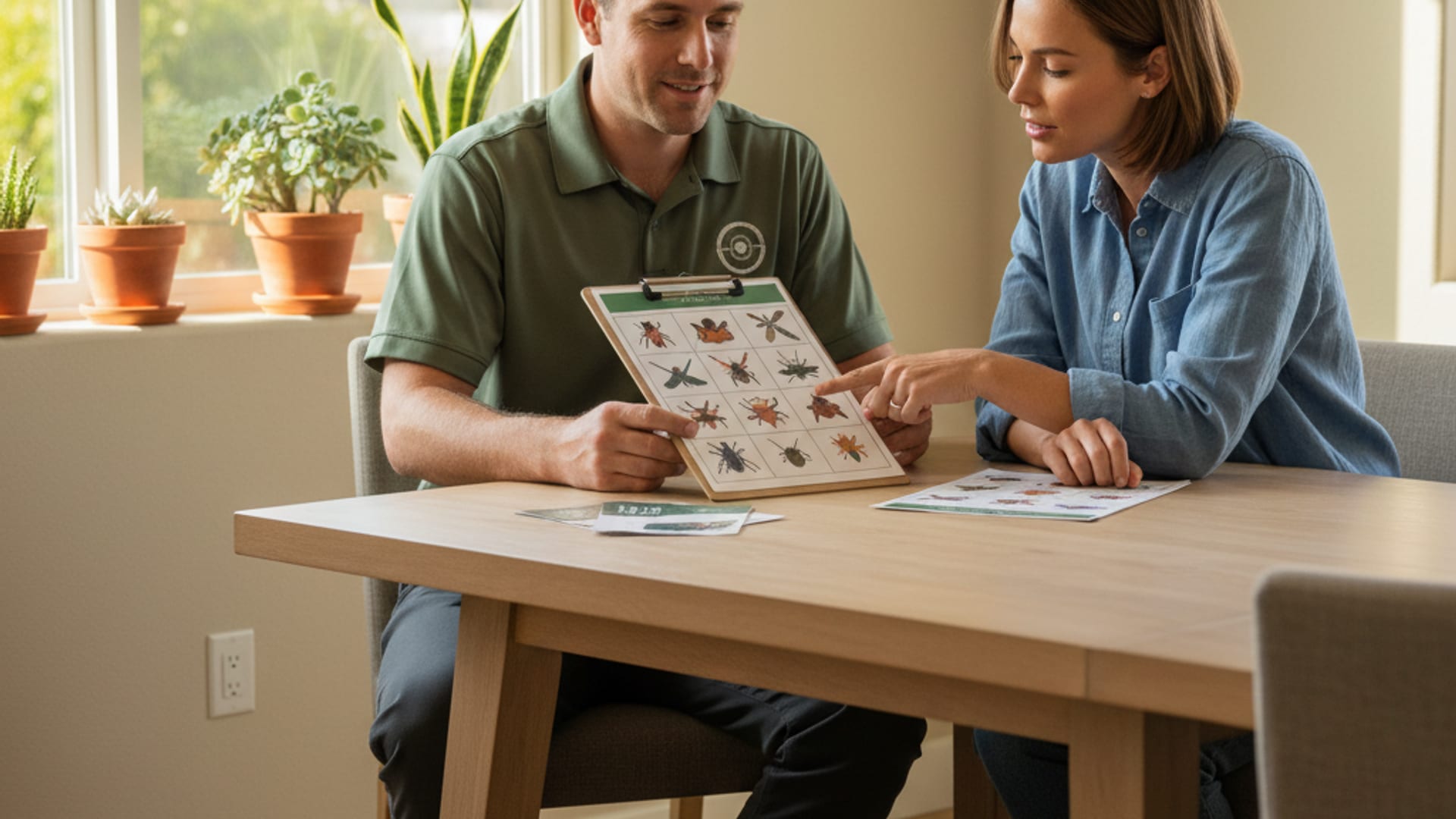
Pricing and how we work
How does pricing work?
We have no price list, because we do not do the work. The licensed company you are matched with quotes after an inspection. Price moves with property size, how far the activity has spread, and whether you need a one-time visit or recurring service. Bed bug work also depends on the number of rooms and whether the protocol is heat or chemical, and termite work depends on species and scope. Ask for the full price in writing before any treatment starts.
How much does termite treatment cost?
Termite pricing depends on species, the extent of the activity, and whether the job is a local treatment, a whole-structure fumigation, or subterranean trenching. An inspection comes first so you know exactly what species is present and which treatment actually fits, since the wrong protocol on the wrong species wastes money and doesn't solve the problem.
Is there a travel or trip fee?
Ask when you book. We charge you nothing, and the company you are matched with sets its own terms, so ask whether travel is inside the quoted number or billed separately before you agree to the visit. Whole-structure fumigation is Branch 1 work and a separate licensee, so ask how that portion is quoted too.
Are inspections free?
That depends on the company, so ask on the call. What should always happen first is the same: the inspector identifies the species, maps the activity, and quotes the treatment before anything is applied. A clear phone photo sometimes gets you a straight answer on an easy one, like an ant trail.
Pests we cover
What kinds of pests do you handle?
General pest (ants, spiders, roaches, silverfish, earwigs), termites (drywood and subterranean), rodents (mice, rats, roof rats), bed bugs, cockroaches (German, American, Oriental), spiders (including black widow and brown widow), wasps and bees, mosquitoes, fleas and ticks, and commercial pest management. Tell us what you are seeing and we match it to the right specialty.
Drywood vs. subterranean termites, how do I know which I have?
UC IPM says drywood termites often expel their fecal pellets through surface openings, and those distinctive six-sided pellets may be the first clue to their presence. For subterranean termites, shelter tubes (sometimes called mud tubes), made by workers from saliva mixed with soil and bits of wood, are the most commonly seen evidence. The inspection is what identifies the species, and the protocol follows from it.
Are bed bugs a sanitation issue?
No. The CDC puts it plainly: bed bugs are in five-star hotels and resorts, and how clean a place is does not determine whether bed bugs are present. They hitchhike in on luggage and used furniture. What they need is a targeted protocol, heat or chemical, chosen after an inspection.
Do you do humane bee removal?
Honey bees get treated as pollinators first. Ask whether a local beekeeper or a live bee removal company will collect them before anyone reaches for a pesticide. The County says it cannot remove feral honey bees from private property, and it does not recommend removing them yourself, because bees can become agitated and you or others may be stung. It also says the entire county is considered colonized by Africanized honey bees, which defend their colonies more intensively and with less provocation than other bees. Killing bees should be the last option, not the first.
What about mosquitoes, can you really make a yard usable?
It gets better, and the water matters more than the spray. UC IPM says mosquito larvae live and grow in ponds, bird baths, and any other objects containing standing water, that management should focus on controlling mosquito larvae and standing water, and that overwatering outdoor landscapes can lead to standing water. So walk the yard and empty what holds water first. Treating adults without that leaves the source producing more.
Scheduling and availability
How soon can someone get out to me?
Scheduling belongs to the company you are matched with, not to us. Say on the call whether it is urgent, a wasp nest by a doorway, rodents in the attic, a bed bug find, and ask them for a specific arrival window before you agree to the visit.
Is after-hours commercial service possible?
Ask for it when you call, and say it is a requirement rather than a preference. Restaurants usually want service after close or before open so nothing is applied in front of customers. Settle access, who locks up, and what has to be wiped down afterwards with the company before the first visit, not during it.
Can you treat multiple issues in one visit?
Usually, and it is worth asking. A general visit that covers the primary pest plus the perimeter, eaves, and harborage is one job. Termite work and bed bug protocols are separate visits, because they need their own time, products, and in the termite case a separate license branch. Ask what is in the quote and what is not.
San Diego County coverage
What cities do you cover?
All 67 cities in San Diego County, coastal communities like La Jolla, Encinitas, Carlsbad, and Coronado; North County inland cities like San Marcos, Escondido, Poway, and Vista; East County including El Cajon, La Mesa, and Santee; South Bay cities like Chula Vista and National City; and backcountry communities from Julian and Ramona to Borrego Springs and Pine Valley.
Do you work with HOAs and property managers?
Yes. Consolidated billing, documented service tickets, pest sighting logbooks, and unit-level callback handling are standard asks for a portfolio, and the companies we match you with can usually cover them. Ask for a certificate of insurance naming additional insureds up front, since that is the one that holds up a contract.
Do you serve backcountry and rural properties?
Yes. Julian, Ramona, Alpine, Pine Valley, Borrego Springs and similar areas are in the service area, and we match them the same way as the coast. Rural properties usually need a broader scope than a tract home, outbuildings, barns, long perimeters, so tell the company what is on the parcel when you book.
Safety and licensing
Are the technicians licensed?
Yes, and the branch matters. California's Structural Pest Control Board licenses three branches: Branch 1 is control of household and wood-destroying pests by fumigation with poisonous or lethal gases, Branch 2 is household pests excluding fumigation, and Branch 3 is wood-destroying pests by insecticides or structural repairs, excluding fumigation. Pest Pros San Diego holds none of them, and we connect you with companies that hold the right one. The Board lets you verify a company or licensee before you book.
Are the products safe for kids and pets?
Ask the company before they start. Ask them to confirm that every product they apply is EPA-registered and to show you the label, which governs how and where the product may be used. The licensed company we match you with works to that label, so ask it to name the product, show you the label, and point out where it is going. Say up front if you have cats, birds, or fish.
What if the pests come back?
Some recurring programs include re-treatment between visits, and some one-time treatments carry a warranty window. Neither is automatic and neither is ours to promise. Ask what is covered, for how long, and what voids it, and get the answer in writing before you sign off on the job.
Do you use eco-friendly or organic products?
Ask when you call, and be specific about what you want avoided. Integrated Pest Management puts physical exclusion, habitat modification, and targeted application ahead of broadcast spraying. UC IPM says the most successful and longest-lasting strategy for rat control around structures is exclusion, building them out. A company that leads with sealing entry points and removing harborage is working that way. One that leads with a spray is not.
Ready for pest control that actually answers the phone?
Call and we match you with a licensed local pro who quotes the job after inspecting.