
Someone points at a spider on the firewood, under a fence board, or on the garage wall and calls it a wood spider. That label is a habit, not an identification. In San Diego County it can mean a hunter that lives with pillbugs, a ground runner that wandered in from the yard, a funnel weaver in the shrubs, or a widow tucked into dry clutter.
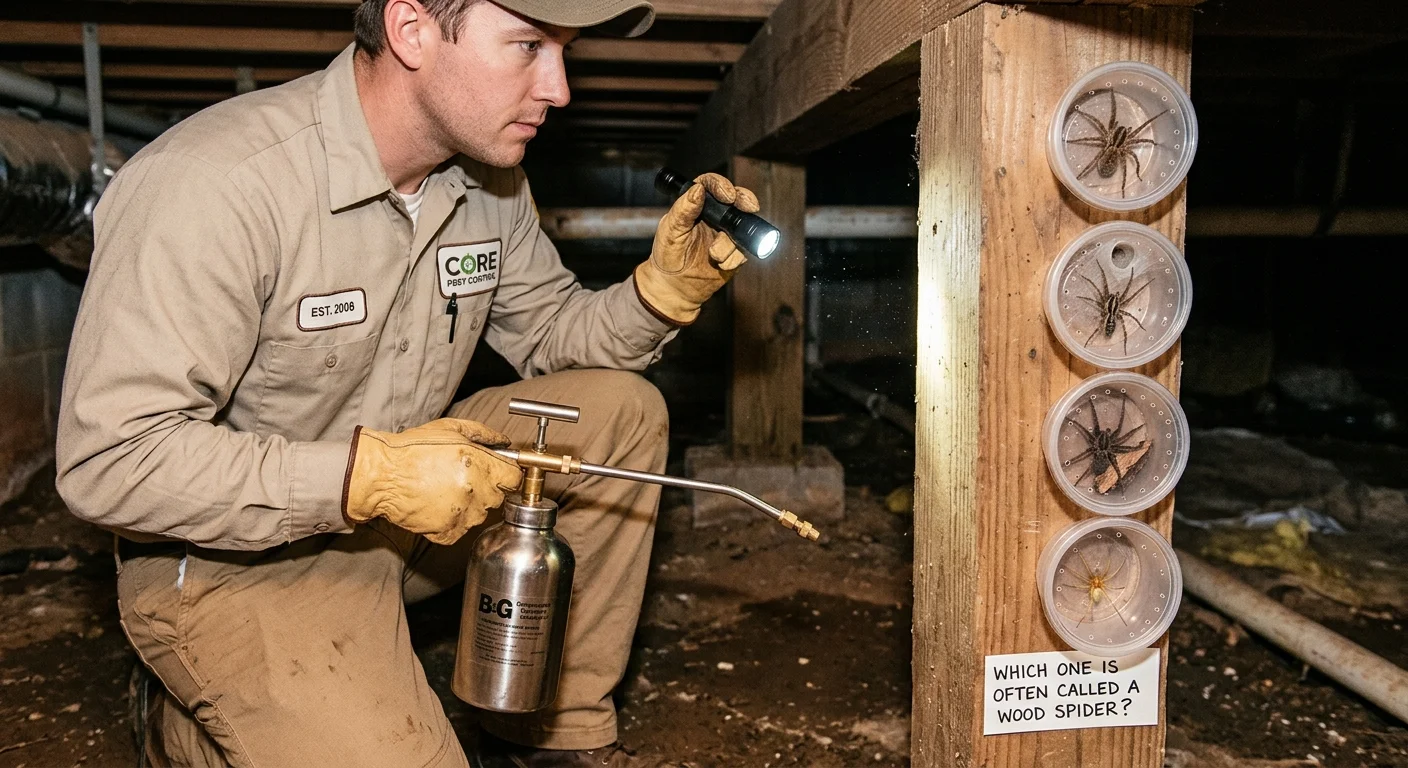
Why wood spider isn’t one precise identification
Wood spider is a common name with no single scientific match. People use it for almost any brown or reddish spider found on lumber, in a woodpile, or along a fence. Search results then pile those animals together, so one photo from a Chula Vista garage and one from an Alpine shed get treated as the same pest. They are not.
National writeups often apply the name to the woodlouse hunter, a reddish hunting spider that feeds on pillbugs and sowbugs. That animal is widely reported in North America. A damp board in a San Diego yard is the kind of place it would use. That still is not a county survey, and it is not proof of what is sitting on your 2x4. Other homeowners mean a wolf spider that ran in from the patio. Others mean a funnel weaver whose sheet web sits in ice plant or juniper. Others mean a western black widow in a woodpile, which is a different problem.
UC IPM is the source to trust for California spiders. Most spiders here are predators of insects, not a medical emergency. UC IPM names the western black widow as the main spider in California that can cause serious injury. It also states that brown recluse spiders and hobo spiders do not live in California. A tan spider on stored lumber in El Cajon is not a recluse ID. Do not treat a web search nickname as a species name.
The common spiders in San Diego guide is the better starting map. Use wood spider as a search term, then drop it once you have shape, web, and location. One blurry phone photo does not lock a species. A licensed inspector looking at the live animal, the web, and the harborage can get closer than a nickname ever will.
Spiders are arachnids, not insects. They have eight legs and two body regions. They do not have wings or antennae. That is enough to separate them from ants, beetles, and sowbugs sharing the same board. It is not enough to name the spider.
Which body features and webs to document
Do not handle the spider to get a better look. Photograph from a safe distance, then add a second shot with a coin or key in the frame for scale. A licensed company can work from clear photos plus what you say about the room. Guessing from memory after you smashed it does not help.
Capture the whole body first, then the front of the head if you can do it without touching. Note color of the head region versus the abdomen. A reddish or orange front with a paler, smoother abdomen is one pattern people tie to woodlouse hunters. A mottled brown body with long, spiny legs and a runner’s posture is closer to a wolf spider. A glossy black abdomen with a red or orange hourglass on the underside is the western black widow pattern UC IPM describes. You will not see that hourglass from above. Do not flip a spider to check.
Web type matters as much as color. Orb webs on eaves are a different family than a funnel with a sheet on low plants. A silken tube or tent tucked into a crack in a board is a retreat, not a prey-catching orb. Many hunters do not use a capture web at all. They walk, wait, and take prey on the surface. If you never see a classic web, that is a clue, not a missing infestation.
Eye arrangement is useful for trained eyes and almost useless in a dim garage photo. Some hunting spiders have six eyes. Many others have eight. Do not count eyes on a moving animal with a phone flash and then treat that count as a diagnosis. Write down what you can defend: size next to a coin, colors, whether it ran or sat, whether silk was present, and whether the abdomen looked round and shiny or mottled.
If someone was bitten, do not name the spider from the mark. UC IPM notes that most spiders cannot break human skin easily, and that even where widows are common, bites are quite rare. A nickname like wood spider does not tell a clinic what venom, if any, was involved. Seek medical advice for a suspected bite. Keep the animal only if you can contain it without putting a hand on it. Our spider control page is for activity in the structure, not for reading a welt.
How the discovery location narrows the possibilities
Where you found it does more work than the nickname. San Diego County is not one climate. A woodpile against a stucco wall in El Cajon stays hot and dry. The same stack under a coastal eave in Encinitas or Oceanside stays damp from irrigation and marine layer. Those two stacks do not favor the same animals.
Coastal north county yards collect spiders where mulch, railroad ties, and overwatered ice plant stay wet. Pillbugs and sowbugs thrive in that moisture, and hunting spiders follow the prey. Inland north county and East County sheds collect them in dry clutter: firewood, cardboard, unused pots, and the dark corner of a garage that never gets opened. South Bay and older central neighborhoods add crawl spaces, stored lumber, and gaps at garage weatherstripping. Canyon lots add eucalyptus bark and leaf litter against the slab.
UC IPM describes western black widows in holes, cracks, crevices, trash, and clutter around homes, barns, and outbuildings. Woodpiles and undisturbed garage corners fit that list. A shiny black spider deep in stacked oak in Lakeside or Ramona is a different concern than a brown runner crossing a Clairemont kitchen at night. The first belongs in the woodpile conversation. The second is often a hunter that followed insects through a door gap.
Ask what the spider was doing. Sitting in a funnel on the foundation shrubs after a dewy morning points to a weaver. Crossing open floor at speed points to a hunter. Hanging in a messy web in a still corner of the garage is another pattern. Daytime spiders out in the open, per UC IPM, are unlikely biters. The ones that stay hidden in dry, undisturbed spots are the ones to treat with more care, especially if the markings match a widow.
Indoors, note the room. A single spider in a bathtub often fell in and could not climb out. Repeat sightings along the same baseboard, or fresh silk returning after you sweep, point to harborage and prey still in the structure. Moisture in a Carlsbad utility room, a leaky hose bib in National City, or irrigation soaking the foundation in Poway all keep insect prey close to the house. The spider is following food. Sprays that skip that source do not hold. Our notes on spider repellents cover why a scented bottle is not a control plan.
When recurring activity needs a licensed inspection
One spider on the firewood is not a program. Recurring indoor sightings, silk that returns on the same eaves, or widows in places people reach are the threshold. Kids’ toys in the garage, shoes left by the door, and stacked boxes along a dark wall turn a woodpile animal into a contact risk even when the spider is not hunting people.
UC IPM’s management advice is blunt. Focus on webs and hiding places. Seal cracks in the foundation and gaps at windows and doors. Keep screens intact. Cut clutter on the floor and along the foundation. Remove exterior webs with a broom or a strong hose. Pesticides are not generally the first tool. That matches how a careful Branch 2 company should talk. General pest work in California sits in Structural Pest Control Board Branch 2. Fumigation is Branch 1. Wood-destroying work is Branch 3. Spider work is not tenting, and this brand does not hold those licenses. We match you with licensed, insured companies that do.
Before anyone applies a product, read the EPA consumer pesticide safety basics and follow the label the licensed company is actually using. Do not buy a consumer concentrate because a forum said it is what the pros use. The matched company inspects first, names what it found, and quotes in writing before treatment starts. You can confirm a company on the California Structural Pest Control Board license search.
Exclusion still belongs to you between visits. Pull firewood off the stucco. Keep a gap between stacked lumber and the slab. Fix irrigation that soaks the foundation in Carlsbad or Chula Vista. Store shoes and gloves off the garage floor. Those steps cut harborage for pillbugs, crickets, and the spiders that eat them. They do not replace an inspection when the same corner keeps producing animals.
If the activity is mixed with ants, roaches, or rodents, say so. Prey indoors is why hunters keep appearing. A wider pest control visit can be the honest scope. The spider nickname is not the job description.
When to call us
Call when the same indoor runways keep producing spiders, when silk returns after you sweep, or when you need a licensed look at a woodpile, garage, or crawl space you do not want to reach into. Pest Pros San Diego matches you with licensed, insured local companies for spider control. We do not spray, inspect, or treat the structure ourselves. Call us at (858) 400-6561 and we’ll match you with a licensed local pro.