
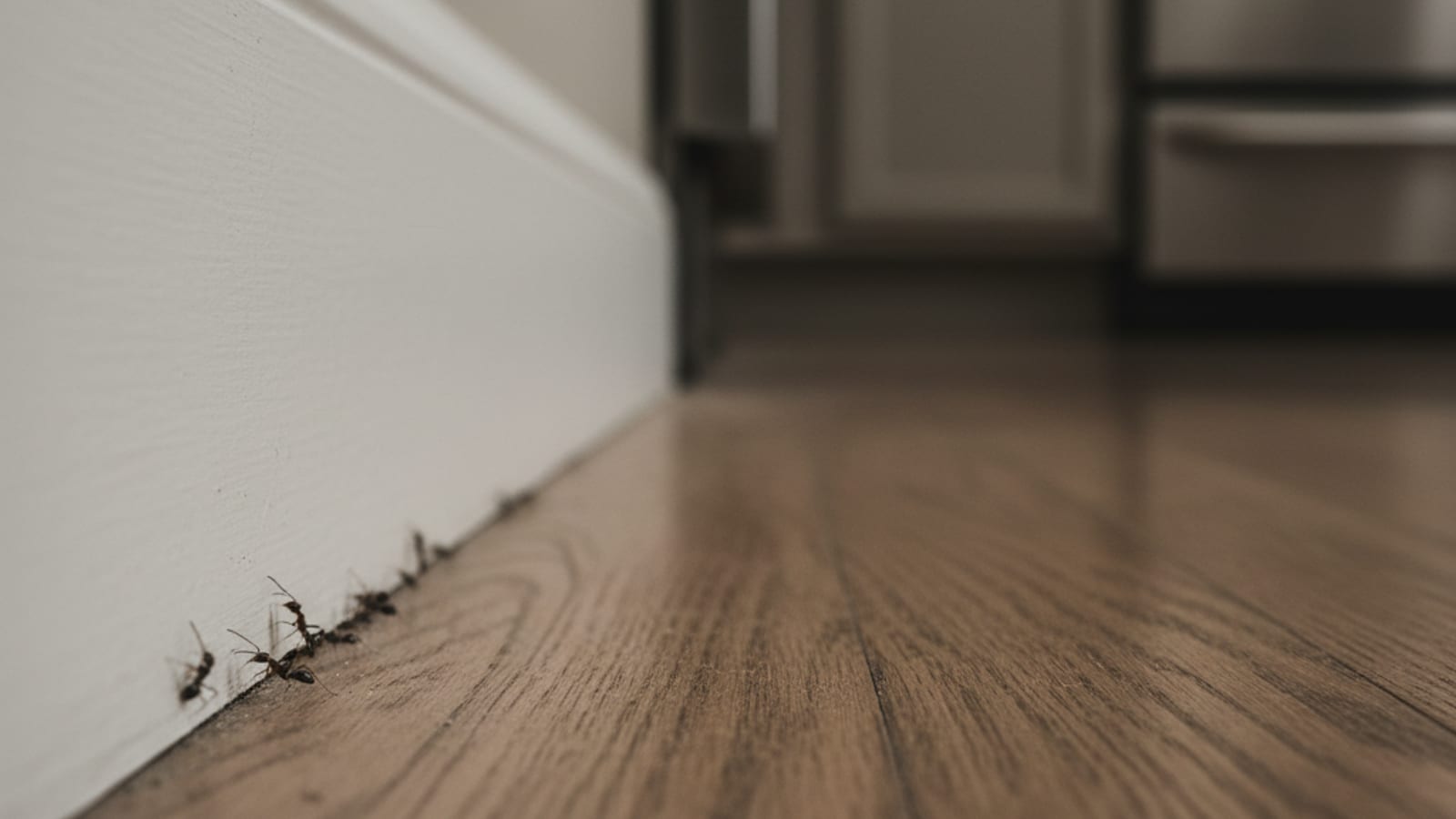
If you live in San Diego County and you sprayed a kitchen trail, you have probably seen this: the line vanishes for a day or two, then returns on a new path, or in another room. That pattern does not prove the spray created new colonies. UC IPM’s point is simpler. Indoor sprays and perimeter sprays kill or scatter the foragers you can see. They do not kill the nest. The colony, including queens, stays in place and sends more workers.
You’re watching the most common household ant in California respond to a method that never reached the nest. Here’s what UC IPM actually says to do instead.
San Diego is Argentine ant country
UC IPM names the Argentine ant, Linepithema humile, as the most common ant in and around California houses and gardens. Workers are about 1/8 inch and dull brown. They nest outdoors in shallow mounds, deeper in dry weather, and they forage indoors for sweets and sometimes proteins.
Argentine ants differ from most other California ants in colony structure. UC IPM: their nests are often linked into one large supercolony with multiple queens. Newly mated queens that found new nests go with workers, not alone. The trail on your counter is a foraging arm, not a small indoor colony you can wipe out with a contact spray.
Why store-bought sprays miss the colony
UC IPM: spraying ants indoors with pesticides will not prevent more ants from entering. Indoor sprays usually are not necessary. Vacuuming or sponging trails with soapy water can remove foragers and the scent trail as well as a spray, for a short time.
Outdoors, a common perimeter spray around the foundation kills only foraging ants. Foragers are a small part of the colony. Queens and the rest of the nest are not in that spray band. Populations can rebound and invade again. On occasion, a barrier spray makes the indoor problem worse by trapping ants that are already inside.
UC IPM also says not to use insecticide sprays while you are using baits. Fast contact products, including some granules that look like bait but contain cyfluthrin or permethrin, kill foragers quickly and do not control the colony.
This article does not claim that a repellent spray causes Argentine ants to split the colony or bud new queens. That mechanism is not in the UC IPM ant Pest Note we used. Pharaoh ants and some fire ants have different responses to disturbance. Do not transfer those stories onto Argentine ants.
What actually works: slow-acting baits plus exclusion
UC IPM: baits are the key insecticide tool in most ant situations, and the only type recommended in most cases. The bait must be slow-acting so workers carry it to the nest and share it with other workers, larvae, and queens. Sweet baits attract Argentine ants year-round. Protein baits are more attractive to them in spring.
For large Argentine ant problems, UC IPM points to liquid borate sugar baits at about 0.5 to 1% in refillable outdoor stations, not high-dose stations that kill foragers before they return. Seeing fewer ants can take several days to a week, sometimes longer. Keep stations filled. If ants ignore a station, move it or offer a different bait. Place stations outdoors near trails and nest openings when you can find them. Indoor baiting can draw more ants inside if you have not found the entry.
Pair bait with sanitation and exclusion, which UC IPM lists first:
- Caulk entry cracks. Follow pipes and wires.
- Store food in washed, sealed containers.
- Clean grease and spills. Take out garbage often.
- Fix leaks. Water attracts ants.
- Keep plants, grass, and mulch away from the foundation. Manage honeydew insects on nearby plants.
If you hire a company, UC IPM says to ask for baits and spot treatments rather than perimeter or monthly sprays. Professionals may have additional labeled tools. Those choices belong on a written proposal after species ID, not in a blog product list.
”But cinnamon worked for my friend”
Vinegar, cinnamon, peppermint, and similar kitchen fixes can break a visible pheromone trail for a short time. UC IPM lists soapy water and some plant-oil contact products as useful for removing foragers, with little residual. That is trail cleanup, not colony control. The same supercolony can open a new path to the same food.
Borate sugar baits, used at a slow-acting rate on the label, are the consumer method UC IPM supports for reaching Argentine ant nests. Mixes you invent in a bowl are not a labeled rate. Follow the label or skip the pesticide.
Why species ID matters before treatment
UC IPM lists Argentine ants as the most common ant in and around California houses and gardens. They are not the only species, and that ranking is not a San Diego indoor-call count. UC IPM’s household-ant table: carpenter ants are larger (about 1/4 to 1/2 inch), nest in wood, and dump sawdust-like frass. Odorous house ants smell strongly when crushed. Pavement ants nest under stones and along sidewalks. Pharaoh ants often nest indoors in wall voids. Food preference and nest site differ, so the bait and the access plan differ.
Have the species identified before anyone treats. A spray-first visit is a guess.
Quarterly service vs reactive treatment
UC IPM says it is unrealistic to eliminate ants from an entire yard. The job is to keep them out of the building and cut food and water. Some companies sell every-other-month perimeter spray programs. UC IPM calls those less effective than a bait-based IPM program and notes California limits on pyrethroid perimeter use because of water quality.
Reactive spraying when a trail appears repeats the forager-only mistake. Recurring service can make sense if it is baiting, exclusion, and monitoring, with products named on a label. It is not a promise that trails will drop to one or two sightings a year. Ask what the visit includes, how they will ID the ant, and how they will judge whether the nest was affected.
What to do if you have an active trail right now
Stop spraying. UC IPM’s emergency steps: remove the food they found, vacuum or wipe the trail with soapy water, find and seal the entry if you can, then put out bait at entries or outdoors.
Photograph the entry if you see it (stucco weep hole, dishwasher gap, door threshold). That helps the inspector. Do not add a second insecticide spray on top of bait.
Call for an inspection if trails persist, you cannot find the entry, or you need a licensed ID. The matched company should identify the species, talk through bait versus any other labeled option, and quote in writing. See ant control. Job length and “ants gone by next week” are not claims this page can make.
Frequently asked questions
Why does spraying Argentine ants make the problem worse?
UC IPM: sprays kill foragers, not the colony and queens. More workers return. A foundation barrier can also trap ants indoors. That is missed-nest control, not a proven budding trigger.
What should I use instead of spray?
Slow-acting bait, sanitation, and sealing entry, per UC IPM. Do not spray while bait is out. Soapy water is for cleaning the trail and removing scent, not for replacing bait.
Does that mean pest control companies do not spray at all?
Some still sell perimeter spray routes. UC IPM prefers baits and spot work, and says to ask hired companies for that. Any spray they use should be on a label for that site. Ask them to explain how it reaches the nest rather than just the trail.
The bottom line
Argentine ants are the usual California house ant because they form linked, multi-queen supercolonies and stay active in mild weather. Contact spray treats the visible trail. UC IPM wants you to take food away, seal the entry, and use slow bait that workers carry home. Pest Pros San Diego does not spray your house. We match you with a licensed local company that should ID the ant and quote before treating.
If you have a trail right now, put the spray can down and call us at (858) 400-6561. We’ll match you with a licensed local pro. The pro inspects before quoting, no obligation.