
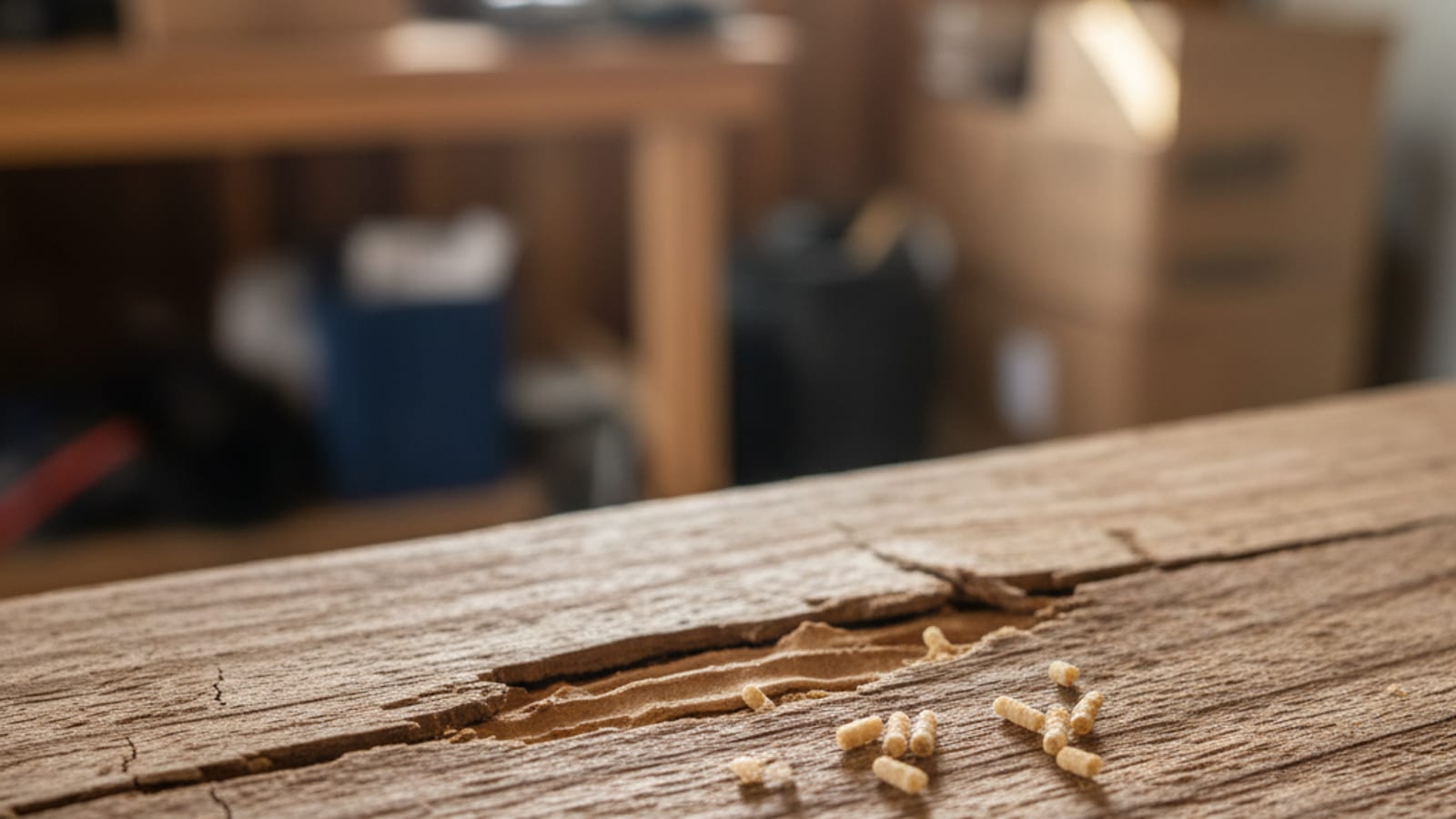
San Diego County has the dubious distinction of hosting both major termite categories that damage homes in North America: drywood termites and subterranean termites. Most homeowners use “termite” as a single word, but the two species are as different as cats and dogs in terms of biology, behavior, treatment, and cost. The wrong treatment on the wrong species wastes money and leaves the damage progressing.
Here’s how to identify which one you have, and why the distinction matters for anyone buying, selling, or maintaining a home in San Diego.
Drywood termites: they live inside the wood
Drywood termites live inside the wood they’re eating: attic rafters, window sills, door frames, eave fascia, deck posts. UC IPM: nests of most drywood species stay entirely above ground and do not connect to the soil. They can survive in dry, sound wood, including structural lumber.
UC IPM: drywood colonies are small, usually fewer than 1,000 individuals, can be widely dispersed, and take years to mature. There can be more than one colony in the same structure. Pellets and kick-out holes are how most people first notice them, not a live insect.
Signs you have drywood termites
The telltale evidence is frass, the pellets drywood termites push out of the wood through small “kick holes.” Drywood frass is dry, granular, and looks like tan or light-brown coarse sand. It often accumulates in small piles on windowsills, under picture frames, on baseboards, or on the garage floor beneath exposed framing. Color can vary from pale tan to dark brown depending on the wood species the termites are eating.
You may also see swarmers, winged reproductives. UC IPM: the most common sighting of drywood termites is flying adults during daytime hours in summer and fall. After the flight they shed their wings. Piles of equal-length wings are a common find.
Other evidence: hollow-sounding wood when you tap on it, a screwdriver pushing into trim or fascia too easily, or blistered paint on woodwork caused by termites eating from the inside out.
What to check on a coastal or older wood-frame house
UC IPM: drywood termites are most prevalent in southern California, including desert areas, and also occur along most coastal regions and in the Central Valley. That is a California range, not a North Park job count. On an inspection, ask whether the company looked at exposed framing, window sills, fascia, and other dry wood the report can actually see. Neighborhood names do not substitute for pellets, kick-out holes, or a written finding.
Subterranean termites: they come up from the soil
Subterranean termites live in soil and reach wood through earthen shelter tubes. UC IPM: the species of economic importance in California include Reticulitermes, and those are the most destructive termites found in the state. They usually nest in or near soil and keep a moisture connection through tunnels or tubes.
UC IPM: mature Reticulitermes colonies can contain hundreds of thousands of individuals.
Signs you have subterranean termites
Look for mud tubes on the foundation, the interior of a crawl space, the exterior stucco, or inside a garage wall. UC IPM: shelter tubes (sometimes called mud tubes) are the most commonly seen evidence of a subterranean termite infestation. Workers make those earth-hardened tubes from saliva mixed with soil and bits of wood or even drywall. Break one open and look: active tubes have live termites inside, and abandoned tubes are dry and hollow.
Damaged wood from subterranean termites looks different than drywood damage, the galleries are packed with a mixture of mud and wood particles (subterranean termites do not clean their galleries like drywood do, which is why drywood produces frass but subterranean doesn’t). Wood looks soiled or muddy when the surface is broken open.
Swarmers for Reticulitermes fly in spring or fall on clear days after a soaking rain, per UC IPM. That timing is different from drywood summer-and-fall daytime flights. Equal-length wings still separate termites from ants.
What to check around soil and irrigation
UC IPM: subterranean termites need moisture, forage year-round in California, and often use wood in contact with soil. Ask the inspector whether they found shelter tubes, wood-to-soil contact, or irrigation against the foundation. Inland city names are places to inspect, not proof that a given lot has subterranean termites.
Why the treatment is completely different
The right termite treatment depends on which species a licensed inspection found. Drywood work targets wood. UC IPM groups drywood methods as whole-structure or localized. Whole-structure treatments (fumigation with sulfuryl fluoride, or heat that raises wood to a stated temperature) are meant to reach infestations you cannot see. Localized treatments go into specific boards. UC: you cannot be sure every colony was treated when only a spot method is used. Ask the company which of the two approaches it’s proposing, and what the inspection found that calls for it. Process notes: termite fumigation in San Diego.
Subterranean work targets soil or the colony. UC IPM: fumigation, heat, freezing, and electrocution devices do not control subterranean termites, because reproductives and most of the colony sit near or below ground. Licensed methods are soil insecticides (often as a trench or injection) or bait stations with a slow-acting insecticide in a cellulose matrix, including insect growth regulators in professional products. Ask which method the bid covers and how the company will check whether it worked.
Wrong species, wasted money: fumigation does not reach a soil nest. A soil trench does not reach drywood living only in wood.
Real estate: why this matters for WDO inspections
If you’re buying or selling a home in San Diego, a licensed inspection is the usual path before treatment. UC IPM: an inspection by a licensed pest management professional is required before subterranean treatments can be performed, and many homeowners first learn of a problem during a real estate inspection. Ask the inspector to name the species and the conditions they found, including shelter tubes, wood-to-soil contact, or moisture, then match the bid to that finding.
A WDO can list drywood, subterranean, or both. Fixr’s national fumigation / tenting range is $1 to $4 per square foot, or about $1,800 to $7,200 on an 1,800 square foot home, as of its January 31, 2025 update. That is a published national guide, not a San Diego quote. Localized drywood work and subterranean soil or bait jobs are priced after inspection. A fumigation line item for a soil colony, or a soil trench for drywood-only findings, is the wrong method. Ask the company to match the bid to the species on the report.
Frequently asked questions
How do I know whether I have drywood or subterranean termites?
Look at what they leave behind. Subterranean termites build mud tubes on foundations and their galleries are packed with soil. Drywood termites leave no tubes; they push frass, small dry pellets, out through kick-out holes, so you find little piles beneath the wood. The distinction decides the treatment.
Which type is more common in San Diego?
UC IPM does not publish a San Diego neighborhood split. Drywood species are most prevalent in southern California and along the coast. Subterranean Reticulitermes occur nearly statewide. On a given lot, pellets versus mud tubes settle the question, not the ZIP code.
Do the two need different treatments?
Yes, and that is why identification comes first. Drywood infestations are treated inside the wood, by localised injection or heat for contained activity or whole-structure fumigation when it has spread. Subterranean colonies are treated at the soil, with perimeter barrier work or bait systems. Treating one as though it were the other fails.
Can one house have both?
Yes, and on older properties it is not unusual. The inspection report lists what was found and where, which is why treatment gets quoted from the report rather than from a phone description.
The bottom line
Drywood termites live in the wood, leave dry pellet frass, and need either local treatment or fumigation. Subterranean termites live in the soil, build mud tubes, and need soil treatment or colony baiting. Same word, different species, different treatment.
If you’re seeing pellets, wings, mud tubes, or hollow-sounding wood, don’t guess which one you have. A licensed inspection names the species before anyone quotes fumigation or soil work. Swarm timing differs by group: when termites swarm in San Diego. Call (858) 400-6561 to get matched with a licensed local pro. Pest Pros does not inspect. Ask for a company licensed for the work on the report (Branch 3 for wood-destroying organisms; Branch 1 if fumigation is proposed).