
The clearest field mark is on the mosquito’s back. An Asian tiger mosquito has one straight white stripe down its thorax. A yellow fever mosquito has curved white markings that resemble a lyre. Leg bands, biting time, and neighborhood alone can’t settle the identification.
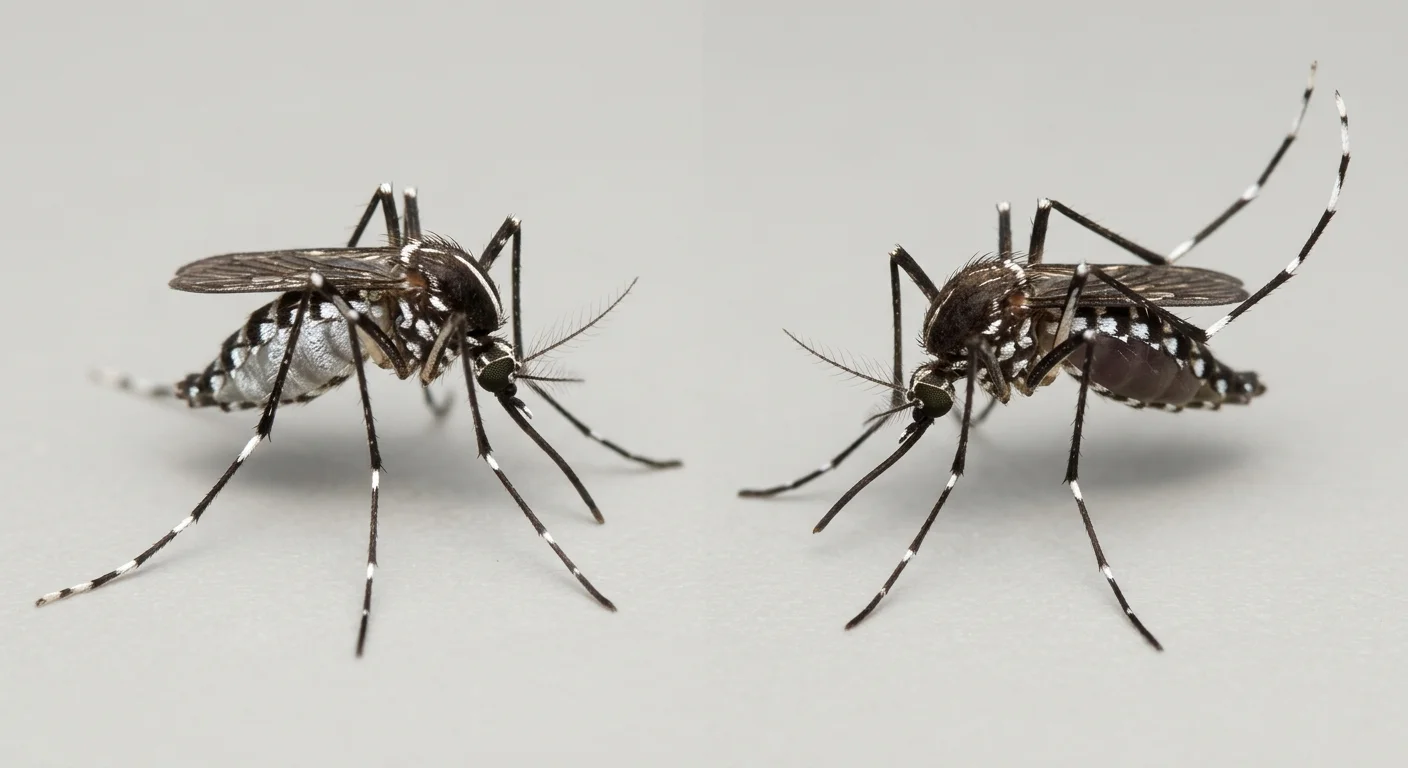
How the two Aedes mosquitoes look different
Both species are small, dark mosquitoes with white markings. The useful difference appears on the thorax, directly behind the head. That area must be visible in a clear, top-down photograph.
The California mosquito identification guide describes the two patterns this way:
| Feature | Asian tiger mosquito | Yellow fever mosquito |
|---|---|---|
| Scientific name | Aedes albopictus | Aedes aegypti |
| Main thorax mark | One straight white “racing” stripe | Curved white stripes forming a lyre pattern |
| Base color | Black | Dark brown |
| Legs | White bands | White bands |
| Best clue | Single white centerline | Several curved white lines |
The Asian tiger mosquito’s stripe runs lengthwise along the center of its back. Think of a narrow painted line on a dark road. The yellow fever mosquito has several separate lines. Those lines curve along the sides and create the lyre-like shape.
White leg bands don’t decide the question. Both species have them. A striped abdomen isn’t enough either. Start with the thorax, then use the other markings as supporting evidence.
Photo angle matters. A side view may show the legs while hiding the decisive pattern. Reflections can also turn dark surfaces into false white lines. If possible, photograph the mosquito from above without handling it. Keep the original image so an inspector can zoom in.
A blurry photo may support an Aedes identification without supporting a species identification. That’s still useful. “Striped Aedes mosquito” is more accurate than choosing Asian tiger from an incomplete view.
Why biting time and location aren’t enough
Behavior creates useful clues, but it doesn’t separate these two species well. California’s identification guide lists both as daytime biters. Both may also bite near dawn and dusk. San Diego County describes invasive Aedes mosquitoes as active around people, often near legs and ankles.
That means a daytime bite doesn’t prove Asian tiger mosquito activity. The same applies to repeated bites on a patio. Yellow fever mosquitoes can create that pattern too.
Breeding location has the same limitation. Both species use small containers holding standing water. Buckets, birdbaths, plant saucers, watering containers, and outdoor toys can all become relevant inspection points. Indoor containers may matter when activity is reported inside.
San Diego’s varied geography doesn’t replace visual evidence. A striped mosquito found near a Chula Vista patio still needs its thorax checked. The same is true in Carlsbad, City Heights, El Cajon, or Escondido. A sighting west of Interstate 5 isn’t automatically one species. A sighting east of State Route 125 isn’t automatically the other.
Season also won’t provide a species-level answer. San Diego County reports that invasive Aedes activity is strongest during summer and fall. That timing describes the broader local problem, not one unique mosquito.
Use behavior to guide the inspection instead. Record where the mosquito appeared, whether activity occurred indoors, and which containers hold water nearby. Note the biting period without treating it as proof. Our broader guide to mosquito control in San Diego explains how those property conditions shape the next steps.
The visual pattern remains the better field clue. Current surveillance records provide another layer, but they don’t replace a clear specimen or photograph.
What San Diego County data can confirm
Current records make the local comparison clearer. The CDPH Aedes detection table, updated May 1, 2026, lists Aedes aegypti as present throughout its named San Diego County communities. It lists Aedes albopictus as “Not Found” in those current community entries.
The yellow fever mosquito is listed as present in San Diego, National City, Chula Vista, Imperial Beach, Coronado, and La Mesa. The same status appears for El Cajon, Santee, Alpine, and Ramona. North County entries include Carlsbad, Encinitas, Oceanside, San Marcos, Vista, Escondido, and Fallbrook.
The historical table tells a different part of the story. CDPH records past Asian tiger mosquito detections in Barrio Logan and Carlsbad during 2015. It also records a Mission Valley detection during 2019. Those locations now appear in the historical section, not the current “Present” listings.
That distinction matters. The Asian tiger mosquito has been detected locally before. However, the current state table doesn’t list it as present in San Diego County communities. Based on those records, yellow fever mosquito is the stronger current candidate when someone finds a striped Aedes mosquito here. That’s an inference from surveillance data, not an identification of the mosquito in your yard.
“Not Found” also shouldn’t be rewritten as “impossible.” Surveillance records report detections. They can’t prove that a species is absent from every private property at every moment.
San Diego County’s activity map groups invasive Aedes activity together. A yellow area on that map confirms recent invasive Aedes activity, not Asian tiger mosquito activity by itself. Our San Diego Aedes establishment data review explains how to read those records without mixing current and historical detections.
What a licensed mosquito company should inspect
A useful mosquito inspection starts with evidence. The company you’re matched with should review any clear photos and examine a captured specimen when available. The inspector should look for the straight thorax stripe or the curved lyre pattern rather than relying on the common name you used.
The property survey should then follow the activity. Tell the inspector where bites occurred and where mosquitoes were seen resting or flying. Mention indoor sightings separately. That helps distinguish a single visitor from a breeding source around the property.
The inspection should cover containers indoors and outside. Plant saucers, buckets, birdbaths, toys, and neglected watering containers deserve attention. Small pockets of water can be easy to miss when the yard otherwise looks dry. Shared courtyards and common areas may also need to be discussed with the person responsible for those spaces.
Species identification and source inspection serve different purposes. The markings answer which mosquito may be present. The property survey identifies conditions supporting continued activity. A company shouldn’t skip the second step because a photograph looks convincing.
California places general household pest work, excluding fumigation, within the Structural Pest Control Board’s Branch 2 scope. You can use the SPCB public license lookup to check the company and its current credentials. Pest Pros San Diego is a referral service, so we don’t inspect properties or apply treatments ourselves.
San Diego County Vector Control takes requests for a mosquito inspection, and it supplies mosquitofish free of charge for backyard ponds, fountains and unmaintained green pools. That county service isn’t private treatment. It can be a sensible place to report unusual mosquito activity or ask about public surveillance.
For private service, the company you’re matched with should inspect first. It should then explain the proposed work and provide a written quote before treatment begins. We can connect you with a licensed local company through our mosquito control service.
Frequently asked questions
How do I tell an Asian tiger mosquito from a yellow fever mosquito?
Look at the back. The Asian tiger mosquito, Aedes albopictus, carries a single bright white stripe running down the centre of its thorax. The yellow fever mosquito, Aedes aegypti, has a curved pair of markings often described as a lyre shape instead. Both are small, dark, and white-marked on the legs.
Do both bite during the day?
Yes, and that is what separates them from the native mosquitoes people expect. Both are aggressive day-biters, which is why they interrupt patio and yard use rather than just evenings.
Why does the species matter for treatment?
It doesn’t change the method much, because both breed in very small volumes of standing water and both need the breeding cycle broken rather than just the adults knocked down. What it changes is where to look: a saucer under a flowerpot, a clogged gutter, a pet bowl, or a bromeliad can each hold enough water to sustain a population.
When to call us
Call when daytime mosquito activity continues, containers are hard to locate, or the species remains unclear. A licensed local pro can inspect the property and explain the available options. Call us at (858) 400-6561 and we’ll match you with a licensed local pro.