
Scratching in the walls or droppings on a shelf usually means a rodent. It doesn’t tell you which one. San Diego homes get roof rats, Norway rats, and house mice. Identification changes trap size, nest search, and which gaps to seal.
Roof rats: the agile climbers
Roof rats (Rattus rattus), also called black rats or ship rats, are common in San Diego. They’re climbers. Nests show up in attics, walls, trees, and dense shrubs. Scurrying above the ceiling or along a fence line points this way. They have a sleek body, large ears, a pointed snout, and a tail longer than head and body combined. Fur runs black to brownish-gray.
They’re nocturnal and eat fruit, nuts, pet food, and garden produce. Access is often roof gaps, eaves, or utility lines. UC IPM: seal holes larger than 1/4 inch to exclude rats and mice. Don’t use a half-inch rule for rats and a quarter-inch rule for mice on the same house. One standard: anything over 1/4 inch.
Once inside they gnaw wiring, pipe, and insulation. Look for droppings along elevated runways. Trim branches off the roof. San Diego County’s rodent-exclusion guidance is the local how-to on sealing. See rodent control for the licensed work type.
Norway rats: the burrowing ground dwellers
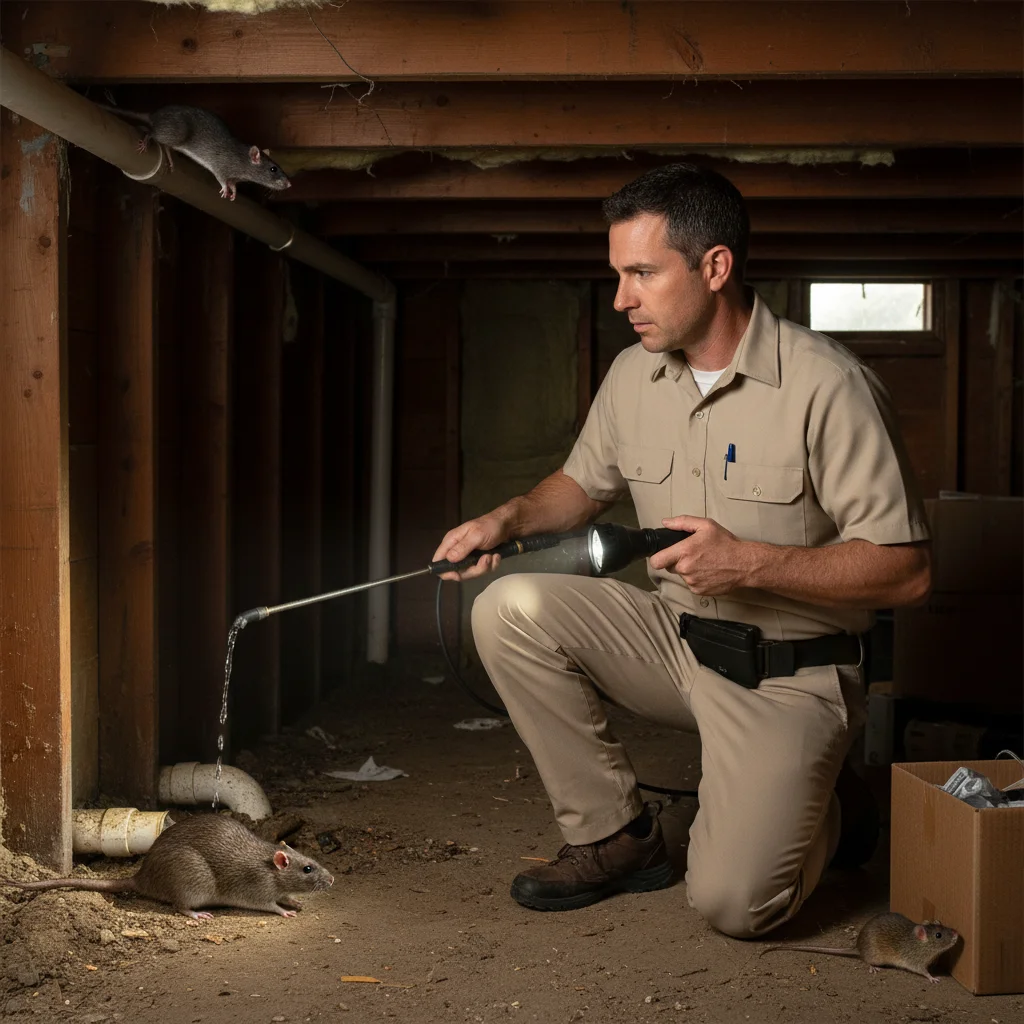
Norway rats (Rattus norvegicus), also called brown or sewer rats, stay lower. They’re stocky, with smaller ears, a blunt snout, and a tail shorter than head and body combined. Fur is coarse brown or gray-brown. They burrow under foundations, slabs, woodpiles, and ground cover.
They’re nocturnal omnivores and need regular water, so leaks matter. Inside, look in crawl spaces, basements, and ground-level storage. UC IPM: when both species share a building, Norway rats typically use the basement and ground floors while roof rats occupy the upper floors. The same 1/4-inch exclusion standard applies. Habits in rodent control in Escondido are the same identification split, not a different species set.
House mice: smaller, still a structural problem
House mice (Mus musculus) aren’t rats, but they get grouped with them because they use the same buildings. They’re much smaller. UC IPM: when resources are stable, a female may have 5 to 10 litters of about 5 or 6 pups in a year, with young born 18 to 21 days after conception and sexual maturity often at 5 to 6 weeks. That’s why a small find can grow fast.
Mice nest in wall voids, cabinets, boxes, and appliances. Look for droppings and gnaw marks near those sites. UC IPM: mice can enter openings as small as 1/4 inch. That’s the same seal size as rats, so seal at 1/4 inch for both. Once you’re sure it’s mice, how to get rid of mice in San Diego covers trapping and sealing as homeowner steps plus licensed help.
Why San Diego homes attract rodents
Mild winters, fruiting landscape plants, and housing against canyons all help rodents. Older and newer construction both have gaps. A leaky hose bib or fallen fruit is enough attractant. County DEH’s rodent exclusion page is the public checklist for building them out.
Health, damage, trapping, and exclusion
UC IPM lists diseases rats can carry, including food-borne illness, leptospirosis, and rat-bite fever, and notes plague is rare in commensal rats. Wild mice are the hantavirus concern in county materials. Don’t treat this blog as a medical diagnosis.
Gnawing on electrical cable is a fire risk. Soiled insulation is an air-quality problem. Prevention is sanitation (sealed food, tight garbage, no outdoor pet food) plus exclusion. UC IPM: the longest-lasting strategy is building them out. Steel wool, hardware cloth, and sheet metal beat foam and caulk they can chew. Trapping and exclusion are separate tasks. A trap that isn’t paired with sealing the 1/4-inch-plus gaps is how the next rodent follows.
Pest Pros doesn’t inspect, trap, or seal. We match you with a licensed company that does. Ask them to quote trapping and exclusion as named line items. Verify the company at SPCB license search. Ongoing monitoring, if you want it, lives on a general pest control proposal from that company, not from us.
Frequently asked questions
What kind of rats are in San Diego homes?
Roof rats are the usual attic and tree-line species. Norway rats use ground burrows and crawl spaces. House mice use much smaller nests but the same 1/4-inch openings.
How do I know whether I have rats or mice?
Nest height, body shape, and tail length help. Rats in an attic sound heavier. Gnaw marks appear with both. Entry size is not the split: UC IPM uses 1/4 inch for rats and mice.
Why do rats keep coming back after I trap them?
Trapping doesn’t close the route. Sealing gaps larger than 1/4 inch and cutting back roof-touching branches is what stops the next one. That’s why exclusion and trapping should be quoted as separate work.
When to call us
If you’ve got droppings, gnawing, or attic noise, call (858) 400-6561 to get matched with a licensed local pro. For price context see rodent control costs in San Diego. For roof-rat attic work see how to get rid of roof rats in San Diego.