
A general pest control visit should be an inspection first, an identification second, and a written scope third. Treatment comes after those, and it’s aimed at the specific pests the inspection found in the specific places it found them. If a company arrives, walks a perimeter with a sprayer, and leaves without naming a pest, you didn’t buy an inspection. You bought a lap around the house.
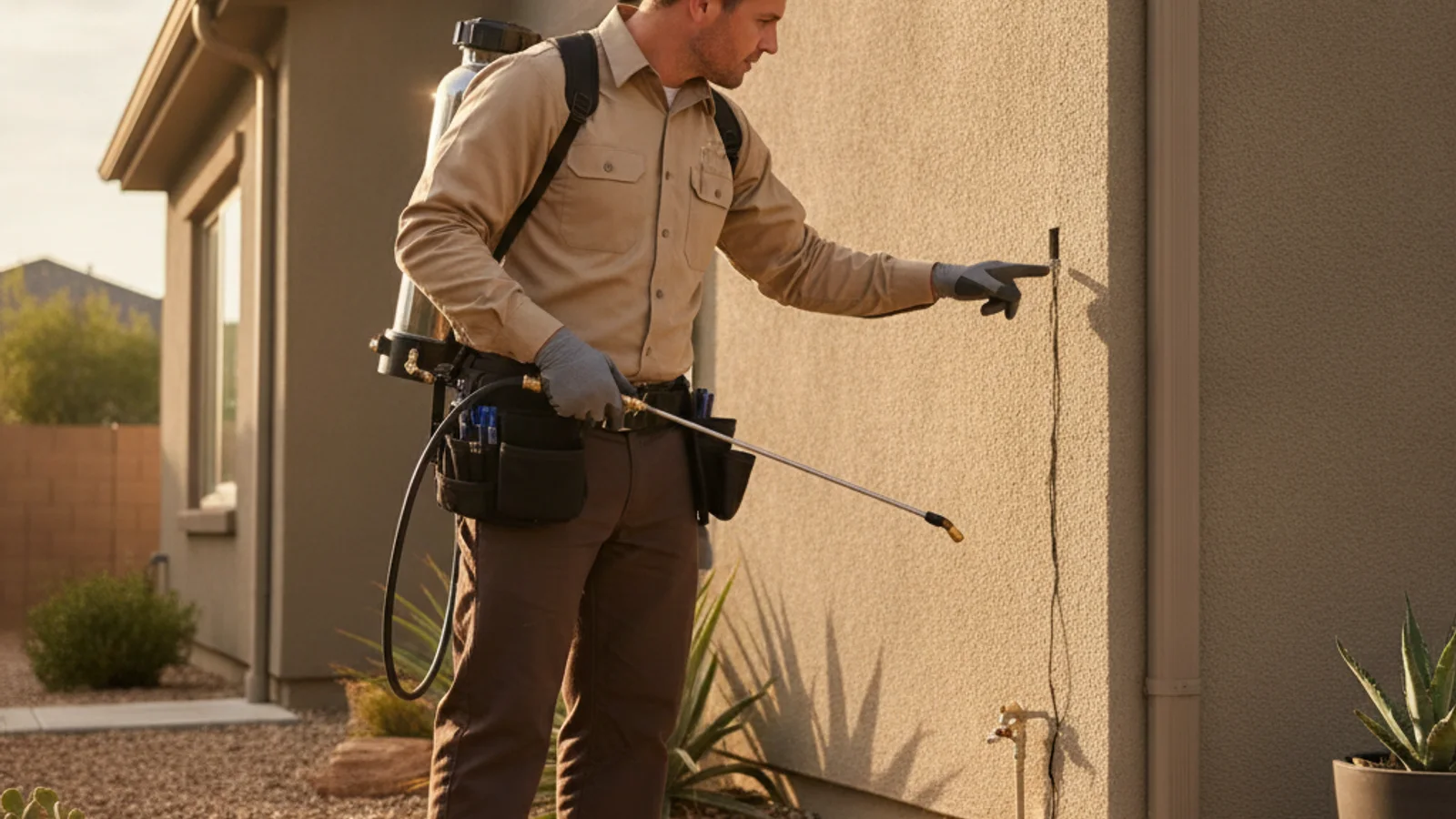
What the company should inspect before recommending treatment
The inspection is where the value sits, because everything after it depends on being right about what’s happening and where. Expect the licensed company to work outside in and to name what it looked at.
Outside, that means the foundation line and where it meets soil, utility penetrations for water, gas, electrical and cable, weep screeds and stucco joints, door sweeps and thresholds, window frames and screens, vents and crawlspace access, roof eaves and fascia where visible, irrigation heads and standing water, planters against the wall, woodpiles, trash enclosures, and the fence line. Inside, it means the kitchen and its appliance voids, under-sink cabinets and plumbing chases, bathrooms, laundry, the garage and its shared wall with the house, closets, and any attic or crawlspace the technician can safely enter.
San Diego County housing stock makes that walk different by neighborhood. An older bungalow in North Park or Golden Hill may sit on a raised foundation over a crawlspace, which puts rodent runs and moisture under the floor at the center of the inspection. Slab-on-grade tract homes in Santee, Poway, and Mira Mesa move the problem to slab penetrations, garage thresholds, and the irrigated planter pressed against the stucco.
Coastal properties in Encinitas, Del Mar, and Coronado carry salt-air wear on screens, sweeps, and vent hardware, which quietly opens gaps that were sealed when the house was new. South Bay and central-city apartments in National City, Chula Vista, and City Heights share walls, chases, and hallways, so an inspection of one unit has to be honest about what it can’t see next door. Rural and backcountry properties in Valley Center, Ramona, and Campo have outbuildings, stored feed, and a long perimeter, so ask where any rodent bait stations will actually sit. UC IPM notes that in California, almost all bait intended for use in and around structures must be in bait stations within 50 feet of a structure, and that tamper-resistant bait stations must be used if children, pets, nontarget mammals, or birds may access the bait.
Ask for the findings in writing, area by area, including what the technician couldn’t reach. An inaccessible void is a real limit on what any plan can claim. Our guide to pest control in San Diego covers the conditions that drive most of these findings.
Which pests a general visit may cover
General pest control is a category, not a promise, and the pests inside it vary by company. Ask for the covered list in writing rather than assuming. Most general programs are built around ants, cockroaches, spiders, occasional invaders like earwigs and silverfish, and often rodents as a named add-on.
Two of those dominate locally. UC IPM calls the Argentine ant the most common ant in and around the house and garden in California, and its colonies aren’t separate nests but a linked supercolony with multiple queens, which is why chasing visible workers rarely settles anything. UC IPM also calls the German cockroach the most common indoor species in California, especially in multi-unit housing, and states plainly that pesticides alone will not solve cockroach problems. A general visit that includes sanitation and exclusion steps alongside baiting is following that guidance. One that skips them isn’t.
Patience is part of the scope too. For cockroach baiting, UC IPM says it may take 7 days or longer before you see fewer cockroaches. A company promising an immediate result is describing a product, not an outcome.
What a general visit does not cover matters just as much. Termites and other wood-destroying organisms sit under a different license branch and a different report, so they’re a separate inspection and a separate contract. Fumigation is separate again. Bed bugs, wildlife, and bees are commonly excluded or priced on their own. If a specific pest brought you here, get it named in the agreement.
Two more things belong in this conversation. The County of San Diego Vector Control Program provides educational rodent inspections free to county residents, and that inspection includes a free Rat Control Starter Kit. The county also offers mosquitofish free of charge for backyard ponds, fountains, and unmaintained green pools. The county states plainly that it is not a pest control company and does not trap, bait, or remove rodents as part of the inspection, so these are education services, not treatment. No private company should charge you for what the county gives away. Second, timing shifts what’s worth treating, which our San Diego pest season calendar lays out month by month.
How occupants, pets, and product labels shape the plan
Tell the company who lives in the house before it writes the plan. Infants, anyone pregnant, an elderly relative, someone with asthma or a chemical sensitivity, dogs, cats, birds, fish tanks, and reptiles all change where a licensed applicator will and won’t place a product, and a good technician wants that information before the estimate, not after.
The registered product label is what actually governs the work. It names the pests covered, the sites where application is permitted, the precautions around people and pets, and any reentry instruction. We don’t publish application rates or mixing directions, and no company should apply a product outside its label because a customer asked. Ask to read the label for anything proposed inside the house. The EPA’s safe pest control pages are a fair primer on how to read one.
Placement usually matters more than product choice. Baits and dusts go into voids, cracks, and enclosed stations rather than open surfaces, which is both how they work and how they stay away from children and pets. UC IPM says insecticide gels and bait stations placed near cockroach hiding areas can also be effective if sources of food and water are removed, and that the advantage of bait stations is that insecticides are confined to small areas within tamper-resistant containers rather than being dispersed widely. If a proposal is broadcast spraying of living space with nothing placed in a void, ask why.
Schools and licensed child care centers sit under their own California notification and posting rules, which are separate from anything that applies to a house. If that is your property, ask the company which of those requirements apply to the job and to show you the notice it will post.
What to compare in a written service scope
Two estimates for “general pest control services” can differ enormously behind the same phrase. Compare the documents, not the monthly figure. Line these up side by side:
- The pests named as covered, and the ones named as excluded.
- The areas treated, interior and exterior, and the ones excluded.
- Visit frequency, and what happens on a routine visit versus the initial one.
- Whether callbacks between scheduled visits are included or billed.
- The products the company expects to use, so you can read the labels.
- Exclusion and sanitation work: included, quoted separately, or left to you.
- Contract length, cancellation terms, and any auto-renewal.
- Warranty, guarantee, and re-treatment language, in full.
Warranty and re-treatment terms belong to the company’s own written agreement. We don’t set them, they differ from one company to another, and a verbal promise isn’t one of them. Get it on paper before you sign.
Then verify the license. California structural pest control is split into three branches: Branch 1 is fumigation with poisonous or lethal gases, Branch 2 is household pest control excluding fumigation, and Branch 3 is wood-destroying pests and organisms by insecticide or structural repair. General pest work is Branch 2. Within a registered company, an applicator may apply pesticides, while a field representative or operator may make inspections, identify infestations, and submit bids. Look up both the company and the individual through the SPCB license search or at search.dca.ca.gov. Cancelled licenses don’t appear in those results, so contact the Board directly if a record comes up empty. Our guide to choosing a pest control company in San Diego goes deeper on vetting.
We don’t inspect, treat, or apply anything. We match San Diego County homeowners and businesses with licensed local companies, and the company you’re matched with inspects first and quotes in writing before treatment begins. Our general pest control referral service explains the process.
When to call us
Call when you want a real inspection before anyone quotes, when two estimates don’t describe the same work, or when a recurring problem hasn’t moved after a season of visits. Identification and pesticide application both require a licensed company, and the written scope is how you tell a plan from a subscription. Call us at (858) 400-6561 and we’ll match you with a licensed local pro.