
Wasp repellent may change activity in a label-approved area. It won’t confirm that an active nest is gone. Repeated traffic through one opening calls for identification, not another unverified product or homemade mixture.
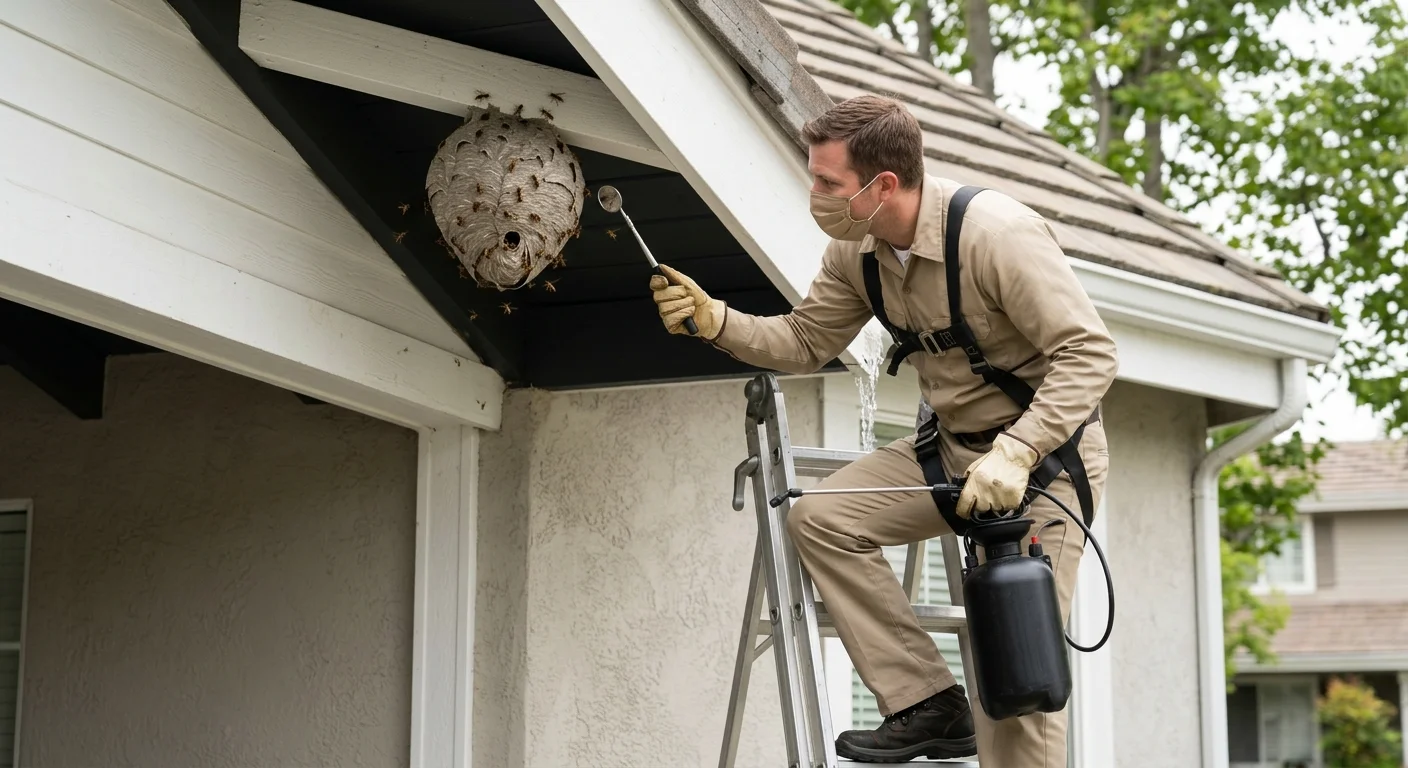
What repellents may change around a property
A wasp repellent should be judged by its label. Start with the exact pest, location, and purpose named there. A package may discuss deterring activity from a limited area. That’s different from locating, treating, or removing a nest.
If the product works as its label describes, you might notice less activity near one treated surface. That observation doesn’t establish what happened elsewhere. Wasps could still be entering a roof gap, landscape cavity, shed corner, or another concealed space. A repellent isn’t a nest-status test.
That distinction matters more here than in most of the country. UC IPM notes that in coastal California south of San Francisco, some yellowjacket colonies survive for several years instead of dying off, and become quite large. San Diego County sits inside that band, so a cavity colony that would be a single-season problem elsewhere can carry over and keep growing. The product label must match the actual site in front of you.
Treat “natural wasp repellent” with the same care. The word “natural” doesn’t answer the practical questions. Check which pest the label names, where the product belongs, and what result it claims. Don’t substitute a homemade mixture for those directions. A mixture without a registered product label gives you no clear use instructions to evaluate.
It helps to know what the shelf actually holds, because three different jobs sit next to each other. A repellent is meant to discourage activity in the area its label names. A nest aerosol is a different product class: UC IPM describes aerosol formulations labeled for use on wasp and hornet nests that shoot an insecticide stream up to 20 feet, so the person applying it can stand back from the entrance. A trap is a third thing again, and it is not aimed at the nest at all. The common lure in a yellowjacket trap is heptyl butyrate, which attracts mainly the western yellowjacket and not other species, and UC IPM says lure traps can reduce the number of localized foraging workers but don’t eliminate large populations. On poison baits, UC IPM is plain that the reliable products were taken off the market in the early 2000s and that the esfenvalerate products that recently became available haven’t been shown to be effective in research trials. Notice what isn’t in any of that: UC IPM’s wasp guidance has no repellent step. We aren’t going to supply one it doesn’t make, or quote a percentage for how well any repellent works.
Keep the decision narrow. Repellents may fit prevention around a specific approved location. They don’t identify the insect, map hidden activity, or prove a nest has stopped. UC IPM’s guidance on social wasps is blunter still: if wasp nests must be eliminated, it is easiest and safest to call for professional help. Our wasp and bee removal service connects San Diego County customers with licensed local companies when the problem has moved beyond simple deterrence.
Exposed paper nest or concealed cavity: the distinction that decides the job
Before you judge any product, work out which of two very different situations you have. You can do this from a safe distance, without getting near the nest.
An exposed umbrella nest under an eave is usually paper wasps. UC IPM describes the nest as hanging like an open umbrella from a single stalk, with open cells you can see from underneath, and says these nests rarely exceed the size of an outstretched hand and hold somewhere between 15 and 200 individuals. The wasps themselves are about an inch long, slender, long-legged, with an obvious narrow waist. UC IPM calls paper wasps much less defensive than yellowjackets, says they rarely sting humans, and says paper wasp nests shouldn’t require treatment unless they are near people.
Wasps flying in and out of a hole, with no nest visible, is the yellowjacket case. UC IPM puts yellowjackets at half an inch to an inch long with jagged bright yellow and black bands and a waist so short it is barely visible, and describes them nesting in rodent burrows and other holes in the ground, in wall and ceiling voids, or in a hanging nest completely enclosed in gray paper with a single entrance hole. The numbers are the reason this matters: a yellowjacket colony can reach between 1,500 and 15,000 individuals, and UC IPM says the ground- and cavity-nesting ones defend their nests vigorously, with defensive behavior increasing as the season goes on.
That second case is where a homeowner’s own can becomes genuinely dangerous, and UC IPM spells out why. An underground nest can sit a considerable distance back from the visible entrance, so the spray may never reach the wasps. Even at night, and even with a stream that carries 20 feet, stinging incidents are likely, and the freeze-type products aren’t guaranteed to stop every wasp that comes out. Agitated, partly poisoned wasps turn up some distance from the entrance the following day. UC IPM’s conclusion is that nest removal for subterranean or cavity-dwelling yellowjackets isn’t practical, and that hiring a professional reduces the risk to you and your family.
Two lookalikes are worth ruling out while you are at it. Mud daubers are dark, thread-waisted, build a small hard mud nest, and rarely sting; UC IPM says their nests can be removed in winter without spraying. Honey bees are less brightly striped and hairier, usually nest inside a cavity in a tree or a house, and are a different call entirely.
Why active nest traffic changes the decision
One wasp crossing a yard tells you little about its destination. Repeated movement through the same opening is more useful evidence. Watch from an ordinary walking area and note the location. Don’t move closer simply to get a better view.
Look for a repeatable pattern rather than chasing individual insects. Useful observations include:
- Regular entry and exit at one roofline, vent, wall gap, or landscape opening
- A visible nest-like structure attached beneath an eave or overhang
- Activity returning at the same point after a repellent was used elsewhere
- More than one possible opening around the same structural area
- A location involving a shared wall, rental property, or common area
These details change the next step because a surface product can’t tell you what occupies a concealed opening. It also can’t confirm whether the insects you see are the same type named on the package. Identification should come before anyone selects a nest-control approach.
Location also affects access. A low, fully visible structure isn’t the same problem as activity near a second-story roofline. Traffic beside a frequently used doorway differs from activity at the far edge of a property. If the opening sits in a shared wall, a rental, or a common area, it may involve space controlled by a landlord, manager, or association. Record that context before arranging service.
Don’t treat a hidden opening as an ordinary surface. Instead, document where activity begins, when you noticed it, and which products were already used. Our San Diego wasp nest removal guide explains the broader removal decision. If the insects appear connected to a ground or concealed cavity, review the yellow-jacket nest decision guide before contacting a company.
How to read a registered product label
Ignore the strongest phrase on the front panel for a moment. Turn to the detailed label and compare it with your situation. Four parts of it do the work: the target pest list, the approved use sites, the directions for use, and the precautionary statements. Read those four and nothing else decides the question. The goal isn’t to find a product that mentions outdoor pests generally. It’s to confirm that the written directions clearly address the pest and site you have.
Start with the target pest list. Look for “wasp” rather than assuming every flying-insect product serves the same purpose, and look for whether yellowjackets are named separately from paper wasps. If you can’t identify the insect, the label can’t solve that uncertainty. Save the package information and ask a licensed company to identify what’s present.
Next, check the approved use sites. “Outdoor use” alone may not answer whether the product is intended for eaves, patios, plants, wall openings, or occupied gathering areas. Read the complete site language. If your location isn’t clearly covered, don’t improvise an application method.
Then separate repellency from nest control. A repellent claim addresses deterrence within the label’s stated scope. It doesn’t automatically include nest treatment or removal. Packaging that names wasps may still describe a different job than the one you need.
Read the directions for use and the precautionary statements together. The precautionary statements are where the protective clothing and eyewear requirements sit, and UC IPM’s own advice for anyone treating a nest is clothing covering the entire body, gloves, a veil over the face, and protective eyewear. Don’t borrow instructions from another product, online video, or homemade recipe. The container in your hand is the source for that product’s intended use. The EPA’s pesticide safety guidance provides a starting point for household pesticide and label information.
Also note what the label doesn’t settle. It can’t verify the species at your property. It can’t confirm the number or location of nests. It can’t determine whether a roofline opening leads into a concealed space. Those are inspection questions.
If a product has already been used, keep its exact name and label available. Tell the company where it was applied and what you observed afterward. Don’t describe the product only as “spray” or “natural repellent.” Exact information gives the company a clearer starting point without guessing.
When a licensed company should identify the nest
Call a licensed company when activity stays tied to one location, the opening is concealed, or identification remains uncertain. Professional identification also makes sense when the suspected nest sits above normal reach or involves a shared part of a building.
The company should first identify the insect and inspect the accessible area. It can then explain whether you’re dealing with an exposed structure, concealed activity, or another flying insect. The proposed work should follow that finding, not the product already sitting in your garage.
This step matters when bees and wasps could be confused. Don’t select a removal method from color, size, or a quick photo alone. Ask the company to explain what it identified and which visible features support that conclusion. Our broader San Diego pest control guide covers what to expect when choosing local help.
Before work begins, ask four concrete questions:
- What insect did you identify?
- Where is the nest or suspected activity point?
- What approach are you proposing for that location?
- What preparation does the property require?
Ask the matched company to identify the insect and inspect first, then quote in writing before treatment begins. Any service terms or re-treatment conditions belong in that company’s written agreement. Pest Pros San Diego doesn’t perform applications, set prices, or issue treatment guarantees.
You can check a company or license through the California Structural Pest Control Board. We match customers across coastal North County, central San Diego, East County, and the South Bay with licensed local pest control companies.
When to call us
Bring in a licensed pest control pro when wasps keep using one opening, the suspected nest is concealed, or the insects haven’t been identified. We’ll connect you with a local company that can inspect the location and explain its proposed work. Call us at (858) 400-6561 and we’ll match you with a licensed local pro.