
Finding a shiny black spider with a distinct red marking can stop you in your tracks. In San Diego County, this is often a female black widow, a spider whose reputation for a venomous bite is well-earned. Understanding where they hide and how to deal with them is key to keeping your home and family safe.
Identifying black widows in San Diego
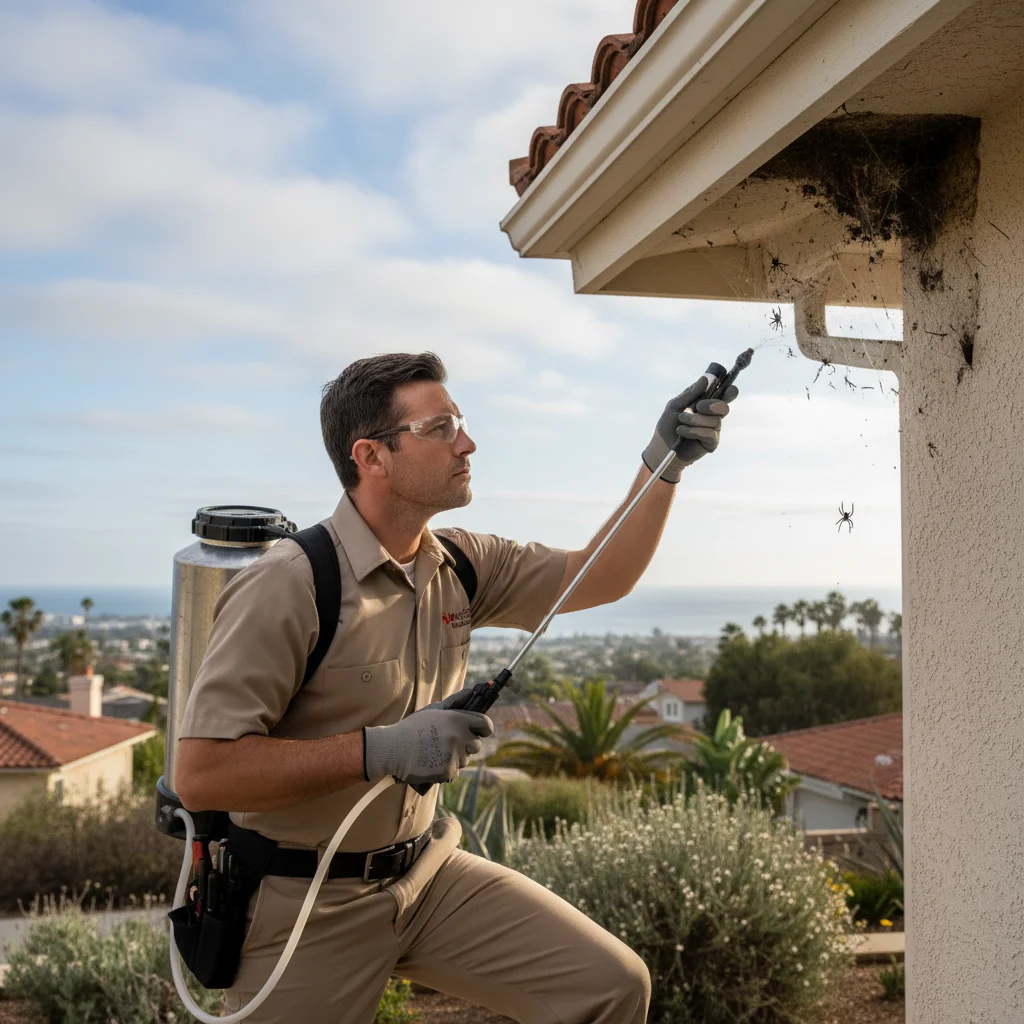
While many spiders are harmless, the black widow is one to take seriously. Luckily, the female is easy to identify. She has a distinctive shiny, black, globular body about half an inch long (not including the legs). The most famous feature is the red hourglass-shaped marking on the underside of her abdomen. Young females might have additional red or white markings on top, which fade as they mature.
Male black widows are much smaller, lighter in color, and generally harmless to humans. You’re far more likely to encounter the female, as she’s the one who builds the web and stays put.
Their webs are another key identifier. Unlike the neat, geometric webs of orb-weavers, black widow webs are messy, tangled, and irregular. They feel surprisingly strong and sticky to the touch. You’ll typically find these webs close to the ground in dark, sheltered locations. According to the UC Statewide IPM Program, bites from black widow spiders are quite rare, even where these spiders are very common.
Common black widow hiding spots around your property
UC IPM says western black widows are found in populated areas almost everywhere in California. They typically nest outside, around the home in holes, crevices, and clutter. In garages they usually make webs by doors, near vents, and in other places where insects may pass by. Because spiderlings balloon onto properties, UC IPM treats elimination as a task that needs to be done repeatedly throughout the year. A thorough inspection of your property should focus on these common hotspots.
Outdoors, check these areas carefully:
- Under patio furniture and barbecue grills: The dark undersides are perfect shelters.
- In and around woodpiles or stacked lumber: Voids between logs are ideal nesting sites.
- Behind air conditioning units and pool equipment: The warmth and clutter offer protection.
- Inside water meter boxes or irrigation control boxes: These provide dark, rarely disturbed enclosures.
- Under the eaves of your house, especially in corners.
- Among dense, low-lying shrubbery or ivy.
Indoors, they are less common but can be found in cluttered, quiet spaces:
- Corners of garages and sheds: Especially where boxes, tools, or old equipment are stored.
- Crawl spaces and basements: These areas are often dark and undisturbed.
- Wall voids and behind appliances that are rarely moved.
Those same woodpiles and cluttered garage corners are where scorpions in San Diego hide too, so clearing them helps against both. Regularly clearing clutter and debris from these areas makes your property less attractive to black widows. Wearing heavy gloves when moving items that have been sitting for a long time is always a good safety precaution.
The risks of a black widow bite
A black widow bite needs medical attention. UC IPM: the venom is a neurotoxin that affects the nerve-muscle junction.
UC IPM: in the unlikely event of an actual bite, the bite itself is painless or may feel like a little pinprick. Almost all medically important black widow bites are from the adult female. At the site there may be a little red mark or red streaking. Within an hour, other symptoms may start to appear. Bite victims might suffer from some but not all of: rigid stomach muscles, sweating (sometimes of just the bitten body part), pain that can be local, radiating, or regional, and urine retention. Less common are numbness, agitation, fever, and patchy paralysis. UC IPM notes that symptoms most often merely resemble those of the flu.
If you suspect you or a family member has been bitten by a black widow, seek medical attention immediately. If possible and safe to do so, try to capture the spider for positive identification. The UC IPM widow Pest Note covers identification and medical aspects of widow spiders in California.
DIY black widow removal: a step-by-step guide (with cautions)
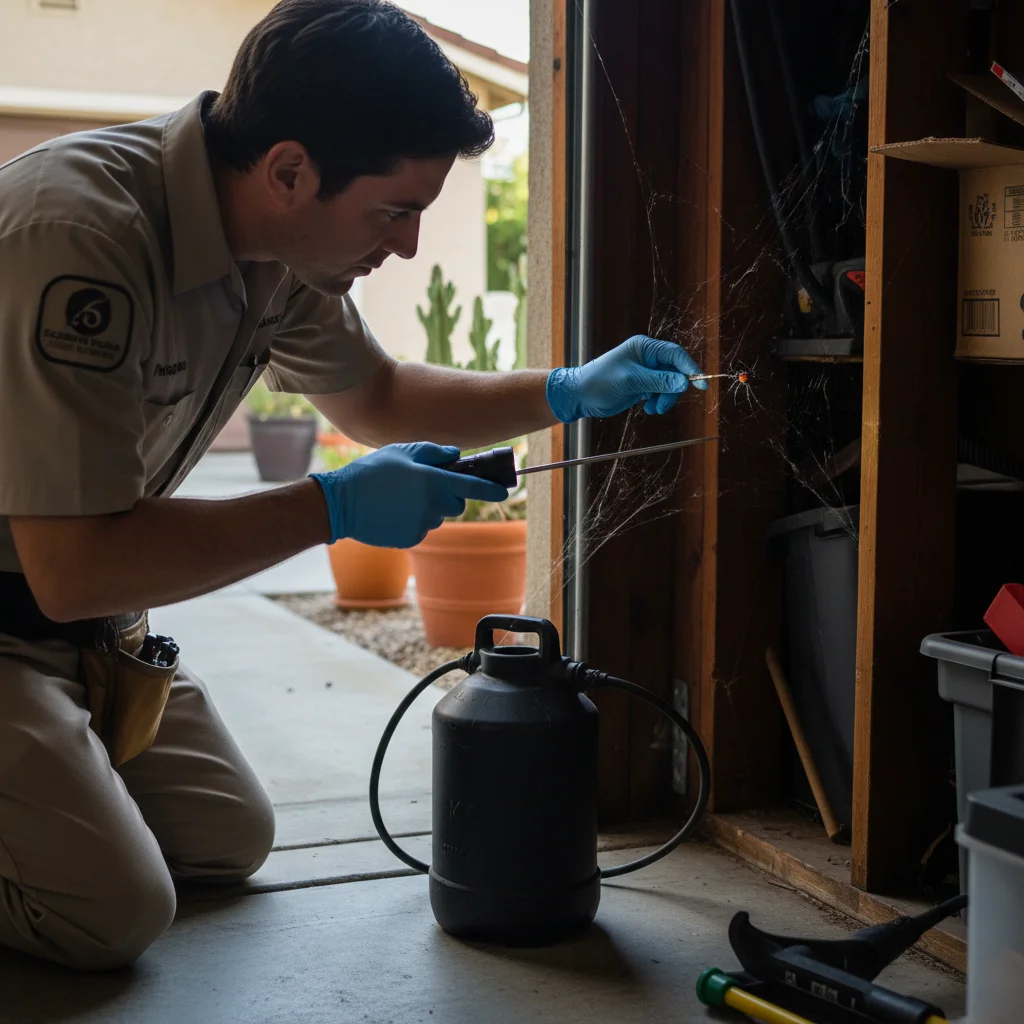
If you find a single black widow and feel confident handling it, you can attempt to remove it yourself. However, this approach comes with risks and must be done with extreme caution. The primary goal is to avoid being bitten.
Safety first: Always wear thick leather gloves, long sleeves, pants, and closed-toe shoes. Keep children and pets far away from the area while you work.
Here’s a common method for physical removal:
- Get a vacuum: Use a vacuum cleaner with a long hose attachment. This allows you to maintain a safe distance.
- Locate the spider and egg sacs: UC IPM describes the western black widow egg sac as yellowish and teardrop-shaped, tapered at the top and bulbous at the bottom. Remove the sac with the spider and web.
- Vacuum them up: Carefully vacuum the spider, the web, and any visible egg sacs. Be thorough.
- Seal and dispose: Immediately after, remove the vacuum bag. Seal it tightly in a plastic garbage bag and dispose of it in an outdoor trash can. If you have a bagless vacuum, empty the canister into a sealable bag and dispose of it the same way.
Important cautions: Never crush the spider with your hand or foot. UC IPM says vacuuming spiders can be an effective control technique because their soft bodies usually don’t survive the process, and that regularly vacuuming or sweeping seldom-used areas helps remove spiders and their webs. Vacuuming the spiders you can see does not keep new ones from moving into the same clutter. Wear gloves when moving undisturbed items.
Why a licensed look is often the safer choice
A vacuum can handle a spider you can see. Multiple widows, webs in high-traffic spots, or sites you cannot reach safely are a different job. Ask a licensed company to inspect harborage, egg sacs, and clutter, then put any labeled product use in writing. Pest Pros San Diego does not apply pesticides. See spider control for matching, and DIY vs. professional pest control for hiring questions.
UC IPM’s widow Pest Note states insecticides do not provide long-term control, and that spider control should focus on removing webs and hiding places. This page does not sell a residual barrier or an on-contact kill.
What to ask the matched company
Inspection should cover the same spots listed above: garages, sheds, crawl spaces, woodpiles, meter boxes, and patio furniture undersides. Ask:
- Which areas will be inspected, and will egg sacs be removed with the webs?
- What nonchemical steps come first (clutter, gloves, lighting that draws insects)?
- If a pesticide is proposed, what is the current label site, and how does that sit next to UC IPM’s note that insecticides do not provide long-term control?
Those answers belong to the company you are matched with, not to Pest Pros San Diego.
Frequently asked questions
Are there black widows in San Diego?
Yes. UC IPM says they are found in populated areas almost everywhere in California and typically nest outside in holes, crevices, and clutter. Favored habitats include woodpiles, picnic tables, trash-can grips, lawn chairs, plant pots with curled lips, and other outdoor objects with sheltered lips or crevices. In garages they often web by doors and vents. Their webs are tangled and irregular rather than the neat wheel shape people picture, and the silk of a mature black widow is very strong.
How dangerous is a black widow bite?
UC IPM says seek medical attention immediately. Bites are quite rare even where the spiders are common. The bite itself is painless or may feel like a pinprick. Within an hour, symptoms may include rigid stomach muscles, sweating, local or radiating pain, and urine retention; less commonly numbness, agitation, fever, and patchy paralysis. Symptoms most often merely resemble those of the flu. If it’s safe, capture the spider for identification.
Can local exterminators treat black widows?
A Branch 2 licensee can propose spider work after an inspection. UC IPM’s sequence is webs, clutter, gloves, and lighting, not a barrier spray as the long-term answer. Removing an egg sac matters because one sac holds the next generation. Ask the company you are matched with to write those steps down.
How do I keep black widows out of the garage?
Cut down the harborage. Store boxes off the floor and away from walls, clear woodpiles and clutter from against the structure, seal gaps around doors and vents, and knock down webs regularly so nothing gets established. Wear gloves when moving anything that has sat undisturbed, because that’s exactly where they sit.
When to call us
If you’re seeing multiple black widows, finding them in high-traffic areas, or simply aren’t comfortable dealing with them yourself, request a licensed inspection. Pest Pros San Diego does not treat. Call us at (858) 400-6561 to get matched with a licensed local pro.
Frequency questions belong on brown widow vs. black widow spiders in San Diego. UC IPM’s widow Pest Note cites a 2012 study in which brown widows outnumbered black widows in urban sites such as homes, parks, and zoos, and notes that brown widows appear to be displacing black widows in some urban habitats. That is the sourced comparison. This page does not add a current San Diego count.