
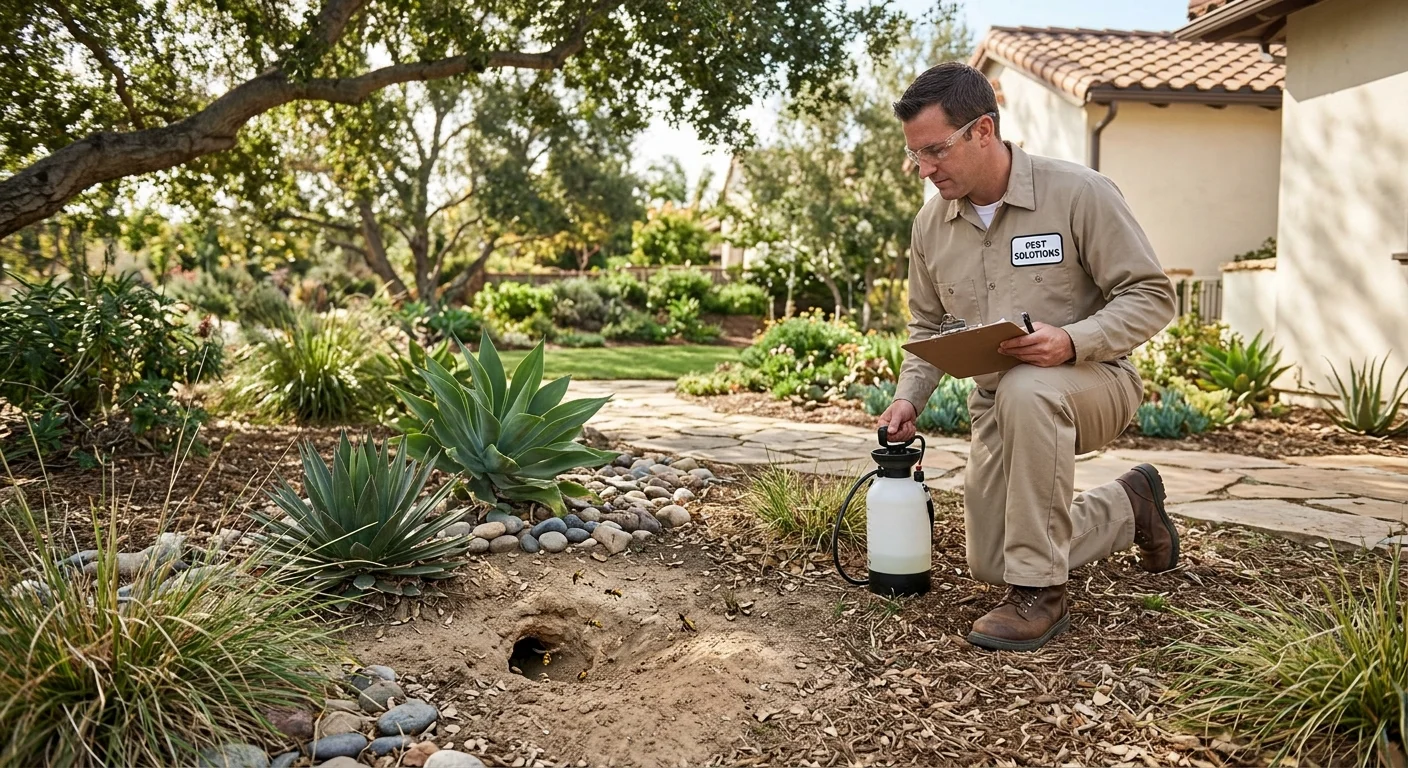
A small hole appears beside the lawn, planter, or patio. Then a flying insect disappears into it. The hole alone doesn’t name the insect, but a few things you can see from well back will narrow it down. UC IPM is direct about the first one: wasps flying from a hole in the ground indicate a probable nest. Stay away from the opening while you work out what’s using it.
Why a ground hole doesn’t identify the insect
“Ground wasp” is a broad homeowner term, not a precise identification. It may describe any wasp-like insect seen near an opening in soil. The name doesn’t establish the species, nest structure, or correct treatment.
Start by separating the hole from the insect. A hole can exist before an insect appears. It can also be used briefly without revealing what lies below. One quick sighting doesn’t connect every nearby opening to the same activity.
Look at the setting without approaching the entrance. Note whether it’s in bare soil, mulch, turf, or a gap beside hardscape. A planted strip in Encinitas presents a different access problem than a bank in El Cajon. A patio edge in Chula Vista creates another concern because people pass close by. Those settings don’t identify the insect, but they help describe the job.
Also note whether fresh soil appears around the entrance. Record the opening’s general shape and its position beside fixed objects. A photo showing a paver, irrigation box, or fence post gives useful scale. Don’t place a ruler beside an active opening.
The insect matters more than the hole. UC IPM puts yellowjackets at 1/2 to 1 inch long, with jagged bright yellow and black bands and a narrow waist that’s barely visible. Paper wasps run about an inch, slender and long-legged, with an obvious pinched waist. Mud daubers are dark and thread-waisted and build hard mud nests, not holes in soil. A distant photo blurs all of that, and glare changes how the bands read. Treat your photo as evidence, not a final identification.
Our broader guide to wasp and hornet nest differences explains why nest appearance can mislead. If the evidence remains unclear, don’t force a species name. Record what you can see and let the inspecting company confirm it.
Which traffic and nest evidence to document
Traffic tells you more than the hole by itself. UC IPM’s rule of thumb is short: wasps flying directly in and out of a single location are probably flying to and from their nest. Watch from well back, never from beside the opening. Use your phone’s zoom instead of stepping closer.
Write down where insects appear and where they go. Note whether they repeatedly use one entrance or move among separate holes. Record whether activity continues during more than one observation. A short video can show movement better than a still image.
Useful details include:
- The entrance’s location relative to doors, walkways, play areas, and work spaces
- Whether traffic appears concentrated at one point
- Whether separate openings show independent activity
- Whether insects land before entering or disappear directly into the opening
- Whether activity seems connected to soil, a wall gap, or nearby hardscape
- Whether yard work, irrigation, or foot traffic passes near the area
These details don’t prove a species. They give the licensed company a clearer starting point. They also explain why the location matters. An opening on an unused slope isn’t the same access problem as one beside a gate.
Don’t dig around the entrance or attempt to expose what lies below. Don’t flood, spray, or plug the opening. Those actions can erase useful evidence and make the activity harder to assess.
If the activity involves an exposed structure rather than a soil opening, use the correct comparison. Our guide to mud wasp nests in San Diego County covers that separate identification path.
For broader property concerns, this San Diego pest control overview explains what to gather before speaking with a company. Photos, locations, and a clear activity description make that conversation more productive.
How solitary wasps and yellow jackets differ
Homeowners often use “ground wasp” for two different ideas. One is an insect using an individual-looking opening. The other is concentrated traffic that suggests a shared nest. Neither pattern confirms a species from a distance.
A lone insect seen once may look like solitary activity. That observation still isn’t enough for a firm label. You may have missed other insects, watched at an inactive moment, or focused on the wrong opening.
Repeated traffic at one entrance points toward a colony rather than a lone visitor. In California the common ground nester is the western yellowjacket, Vespula pensylvanica. UC IPM says yellowjackets usually take over rodent burrows, and will enlarge a tight one by moistening the soil and digging. A colony can hold between 1,500 and 15,000 individuals depending on the species. The nest itself can sit a considerable distance back from the entrance you can see, so the hole tells you where they go in, not how big the problem is.
Use neutral notes when certainty is low. “Dark wasp-like insects repeatedly entering one soil opening” is better than an unsupported species name. “One insect visited separate holes near the planter” is also useful. These descriptions preserve what you actually observed.
Our guide to yellow jacket nests and professional confirmation explains that specific decision in more detail. It shouldn’t replace an inspection when the entrance can’t be viewed clearly.
Don’t confuse ground activity with an exposed paper structure. Location and visible construction are separate pieces of evidence. If you’re comparing an open nest with other nest forms, read our wasp nest identification guide.
Temperament is the practical difference, and it decides how close anyone should get. UC IPM singles out the ground- and cavity-nesting yellowjackets as the ones that defend their nests vigorously when disturbed, and says that defensive behavior increases as the season progresses and colonies grow. Paper wasps are much less defensive and rarely sting people. Mud daubers don’t defend their nests and rarely sting at all. Until you know which one you have, treat an active soil opening as the stinging case. Keep children, pets, and the mower away from it, and don’t stand over it to watch.
When a licensed company should confirm the nest
Professional confirmation makes sense when traffic repeatedly concentrates at one opening. It’s also appropriate when the entrance sits beside a doorway, gate, walkway, patio, or regular work area. The same applies when insects disappear beneath a slab or retaining wall and the nest area isn’t visible. UC IPM is blunt about the homeowner version of this job: nest removal for subterranean or cavity-dwelling yellowjackets isn’t practical, because the nest is underground or otherwise inaccessible, and hiring a pest control professional reduces the risk to you and your family. In some parts of California a local mosquito and vector control district treats nests, so that call is worth making as well.
The company you’re matched with should inspect before recommending treatment. Ask the inspector to identify the insect, the active entrance, and the area that requires access. If identification remains uncertain, ask what additional evidence is needed.
In California, Branch 2 is the practice relating to the control of household pests excluding fumigation with poisonous or lethal gases. You can check a professional or business through the California Structural Pest Control Board license search. Pest Pros San Diego doesn’t hold that license or perform treatments. We match customers with licensed local pest control companies.
Before approving work, request a written quote from the matched company. Pest Pros San Diego has no fee schedule and quotes no prices. The inspecting company sets its price after evaluating the site.
The written proposal should identify what the company plans to address. Ask which areas require access and what preparation belongs to you. Any follow-up, warranty, or re-treatment terms should appear in that company’s agreement.
For help comparing the service itself, review our wasp and bee removal page. The goal is a clear identification and a site-specific plan, not a treatment chosen from the appearance of one hole.
When to call us
Call when repeated insect traffic enters the ground, the opening is near an occupied area, or you can’t identify the activity without disturbing it. We’ll connect you with a company that can inspect the site and explain its written recommendation. Call us at (858) 400-6561 and we’ll match you with a licensed local pro.