
If you’re buying, selling, or just uneasy about a Lakeside property, start with what a termite inspection legally has to produce. California sets who may write the report, what has to be in it, and how fast you get it. That’s the part no company can spin at you.
What actually raises termite risk on a Lakeside property
We have no source on Lakeside’s housing stock or its age, so ignore any company that opens with that. Two things are documented and they’re the ones to work from. Subterranean termites, UC IPM says, “require moist environments” and “usually nest in or near the soil and maintain some connection with the soil through tunnels in wood or through shelter tubes.” Anything keeping soil damp against your foundation feeds that. And whether your house has a sub-area to crawl into or sits on a slab changes what the inspector can physically reach, so find out which yours is before you book and ask the company how it handles the other case.
The rest of the property counts too. California requires the report to call out “earth-wood contacts, excessive cellulose debris, faulty grade levels, excessive moisture conditions, evidence of roof leaks, and insufficient ventilation,” so anything wooden set into dirt is on the list whether it’s a fence post, a retaining wall, or stacked firewood against a wall. Walk it yourself first. Access matters as much: a blocked vent or an unreachable sub-area is written up as an area that could not be inspected, not as an area found clear. On timing, UC IPM notes that in California subterranean termites “can forage year-round,” with foraging “minimal from November to February, moderate in spring and fall, and high, but erratic, during the summer months,” so a quiet winter walk-through doesn’t clear a structure.
What a licensed inspector looks for (and where they look)
The inspection must be made by “a licensed Branch 3 field representative or operator employed by a registered company.” The Structural Pest Control Board defines Branch 3 as “the practice relating to the control of wood-destroying pests or organisms by the use of insecticides or structural repairs and corrections, excluding fumigation.” Scope detail is on our termite inspection service page.
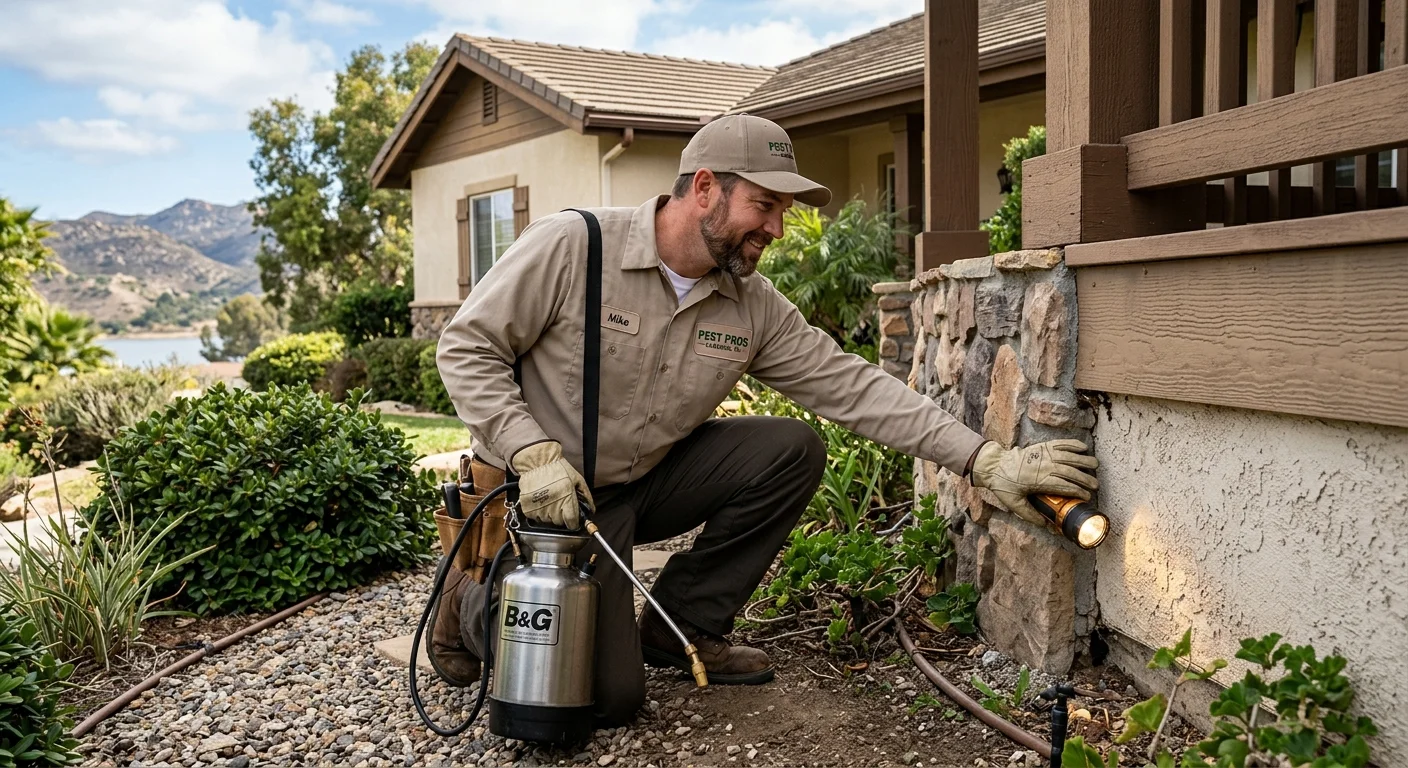
Outside, the route is set by what the report must cover: “the substructure, foundation walls and footings, porches, patios and steps, air vents, abutments,” plus roof framing including “the eaves, rafters, fascias, exposed timbers, exposed sheathing.” UC IPM describes what the inspector is reading along it. Shelter tubes, “sometimes called mud tubes,” are “the most commonly seen evidence of a subterranean termite infestation.” For drywood termites it’s “feeding damage, shed wings, fecal pellets, and kickout holes,” the last being holes “less than 2mm in diameter” through which pellets get pushed out.
Inside, accessible areas and attic spaces get the same treatment, and damaged members have to be named the way a builder names them: “siding, studs, rafters, floor joists, fascia, subfloor, sheathing, and trim boards.” There’s a real ceiling on all of it. UC IPM notes the legal minimum is “visual searches of accessible areas,” and that finding well-hidden infestations “may require removing walls, paneling, and stucco.” More on the signs of termites in San Diego.
Understanding your WDO report in Lakeside
The written report is due to you fast. California requires it to be “prepared and delivered to the person requesting the inspection and the property owner, or to the property owner’s designated agent, within 10 business days from the start of the inspection.” The registered company must also file the address of the property with the board within 10 business days of the inspection starting. The report separates findings two ways:
Section 1: Active infestation or damage
This is “the infestation or infection that is evident.” It gets placed on a “foundation diagram or sketch of the structure” marking “the approximate location of any infested or infected areas evident,” and it carries “recommendations for corrective measures.”
Section 2: Conducive conditions
This is “the conditions that are present that are deemed likely to lead to infestation or infection”: earth-wood contact, cellulose debris, faulty grade levels, excessive moisture, roof leaks, insufficient ventilation. California is blunt that these must not “be characterized as actual “defects” or as actual “active” infestations or infections,” so don’t let a bid treat the two the same way.
Two rights are worth using. If you ask for a bid with the original report, you’re entitled to “an estimate or bid … separately allocating the costs to perform each and every recommendation for corrective measures,” so you can price item by item instead of accepting a lump sum. And every report must carry the notice that “you have a right to seek a second opinion from another company.” Check any company’s license at pestboard.ca.gov.
Common findings and next steps after an inspection
Nobody publishes which findings turn up most often in Lakeside, so read the report on your address on its own terms. What each species leaves behind is documented. Drywood pellets “have six hexagonal sides and are diagnostic for drywood termites.” Shelter tubes are the subterranean giveaway. UC IPM also warns that pellets alone can’t tell you “whether the infestation is currently active or how extensively the infestation extends throughout the wooden piece or structure,” which is worth remembering before anyone prices a whole-house job off a small pile.
Once the WDO report is written, the licensed Branch 3 company that performed the inspection is the one that walks you through the findings, because under Business and Professions Code section 8516 the recommendations are part of that inspector’s report. For active infestations, the options vary. Drywood termites may get a localized treatment for a small colony or a whole-structure fumigation for a widespread one, and structural fumigation is Branch 1 work. Subterranean termites are usually handled with soil-applied products around the foundation or with a baiting system. The report’s recommendations for conducive conditions cover the same list you can check yourself: leaking pipes, crawlspace ventilation, wood-to-soil contact, and cellulose debris against the structure. If the inspection company does that corrective work and you ask for it, the bid is a separate document that itemizes each recommendation. Pest Pros San Diego does not inspect, treat, or price the work. We match you with the licensed local company that does.
Frequently asked questions
How much does a Lakeside termite inspection cost?
Fixr puts a one-time termite inspection at $150 to $350, and that is a national cost-guide range, not a Lakeside quote or our fee. Ask the company what it charges and whether the fee is credited toward treatment if you move forward. The inspector checks the foundation, crawl space, attic, eaves, and any wood-to-ground contact, then writes a WDO report you can hand to a lender or buyer.
Can you connect me with termite treatment and extermination in Lakeside, CA?
Yes. After the inspection, termite extermination in Lakeside, CA gets quoted based on what the inspector finds. Drywood termites get localized treatment or fumigation; subterranean termites usually get a soil barrier or a baiting system. Treatment for termites in Lakeside, CA is priced after the inspection because species and scope drive the cost.
How long until I have the report in hand?
California gives the registered company 10 business days from the start of the inspection to deliver the written report to whoever ordered it and to the property owner. Visit length is a different question and depends on the house and how reachable the attic and sub-area are, so ask the company for its own estimate when you book.
When to call us
If you’ve spotted shelter tubes, pellets, or shed wings, or you’re buying or selling in Lakeside, a licensed Branch 3 company is the one that can inspect and write the report.
What the inspector checks and how the WDO report reads are on the termite inspection in Lakeside page. Call us at (858) 400-6561 to get matched with a licensed local pro.